Showing posts with label AGCHAT. Show all posts

Thursday, August 6, 2020

The Conundrum Of Proper Timing (and why small paddocks can prevent it)

While we are constantly reminded of the need for grazing at the proper time, good plant diversity assures that we are seldom going to have proper timing for all of the plants. At any point during the growing season we will have plants ready to be grazed, yet there will also be plants which are either past the "proper" stage to graze, or not yet there. The photo below demonstrates this. Some grass isn't close to optimum, some is, and others are actually done growing for the time being. 

This area was over 90% bare ground before I grazed this pasture with 275 calves last April and May. This is one of the areas the herd bedded down in for the night, and along with the help of a 2" rain early July, this is the result. Once all of the grass has seeded out, it will be grazed again to take advantage of the seed. When the whole pasture has this kind of diversity, rather than grazing it once, I will be able to graze it at least twice during the growing season (hitting some grasses at the optimum time both passes.)


The following picture is another area in the same pasture where the calves bedded down, giving the ground a super fertilization of dung and urine. Once again, this area was over 90% bare ground.


The ground in the following two pictures were predominantly Russian Thistle. It was grazed three weeks in March with 70 pair in March, followed by 275 calves for five weeks in April/May, then by 40 calves in July. This pasture has roughly an inch and a half of moisture since the first graze. Once again areas in which cattle bedded down are already beginning to grow grass.
This picture speaks loudly about the natural seed bank. In 2006, this was basically bare ground, mesquite, and creosote. That spring the brush was grubbed out and it was planted in Bermuda. Four years later, a farmer tried growing Teff grass for two years, then it was in cotton until 2018 when it was abandoned. There are two more areas of about the same size in this pasture which are looking to be about the same.
The problem with fencing large acreages into small paddocks (especially when starting a grazing project) is that as different plants reach that point of optimal grazing, they may be in small areas scattered through half the paddocks.  Often different species may be located in certain terrain which spreads through all of the paddocks in a pattern which may not give a whole day's grazing in any one paddock...yet have a week or more if you could follow the terrain. This situation can reoccur several times during a grazing season, and (over the course of the grazing season) may amount to a month or more grazing which we miss. Leaving the pastures larger, rebooting herd instinct and practicing IMG allows us to go back and spot graze grasses, as well as forbs or other browse. 

When we merely mimic a herd by rotating them through fences, we improve the soil and plant diversity, yet we forget that in the course of a grazing season, herds of several different species would graze across the same areas, taking whatever the optimum plants were at that time. By reducing the number of interior fences, and herding or using IMG, we are able to better balance the nutritional needs of our livestock with the optimum time of grazing various plant species for soil health.

Wednesday, October 19, 2016

Hypocrisy Of The Current Cattle Markets And World Hunger

With the latest trend in cattle prices, there is little doubt that our government is in collusion with the mega corporations controlling “world trade.” NCBA, led by packers, convinced our government of the “need” to import fresh beef from Brazil. At the same time the record high prices of the last couple of years have seen an astronomical free fall, to the point many producers are wondering how to survive.

The irony is a mere 21 years ago the NCBA was actually the NCA wasn't inclusive of the packers which make up the “beef” end of the industry. Adding to irony is that JBS, the largest cattle feeding and beef packing company was at the forefront of the drive to allow fresh beef imports from Brazil...Where coincidentally, JBS is also the biggest exporter of beef in the country. Yet another amazingly ironic coincidence, is the Brazilian Real is worth just over $0.31. With Brazilian prices at 1.61 Real, US prices would need to drop to roughly $0.70 to “compete.”

Yet the problem with the cattle and beef industry is not isolated. Governments and the media tell us we are need to increase production of food for a growing population. Government programs and nonprofit organizations spend untold billions of dollars supposedly addressing the problem of malnutrition around the world. The problem is not production, but distribution. American dairy producers have been forced to dump over 43,000,000 gallons of milk this year because of “over production.” Produce farmers in California are forced to dump millions of tons of “excess” produce every year, while Mexico exports millions of tons of the same produce to supermarkets here in the USA (while there population is forced to illegally cross the border into our country in order to survive.)

Part of the problem is that food is considered a “commodity” rather than a necessity. As such, production as well as price depends on arbitrary prices and orders determined by a “market” which in reality has become increasingly irrelevant. It is physically impossible for hunger and excess food to simultaneous exist on a planet where food may be distributed to any part of the world within two days. Yet somehow both are existing side by side as corporations dealing in food commodities profit in the billions while conducting business practices which force the destruction of food, and a reduction in people growing food.

The hypocrisy of economists, governments and organizations around the world,claiming to be fighting hunger in the world, is that their market systems and agriculture policies result in the destruction of food rather than the distribution to those in need. Their policies cater to a few mega corporations rather than the survival of the individual farmers growing the food. In my next post I will address how the cattle industry (at least in the USA) we may be able to at least partially circumvent the markets.


Saturday, August 27, 2016

Fundraising For Drone Based Video


Using the right grazing management can bring back your grass to where it was 100 years ago. This is made easier using stockmanship methods which allow you to follow grazing plans without using fences.

Several of the ranchers in this video use are using the stockmanship techniques I taught them in regenerating these ranches as it allows them to concentrate their herds where it is nearly impossible to build fence.

Currently trying to raise money to produce a professionally filmed, drone based, video of these techniques on the Circle Ranch in Hudspeth county, Texas. In order to make the information available to as many as possible, there will be versions in both English and Spanish. Both versions will be available for free in segments on YouTube, as well as for sale on Amazon in all available formats.


A $30 donation will get you a copy of the cd when it is finished! Corporate and non-profits partnering with me on this video will be able to get as many as they want in either version at cost plus shipping, plus be acknowledged in the credits of the video. (please contact me direct for information on partnering with me on the video)  https://www.gofundme.com/2et8s5as


Sunday, August 31, 2014

Underestimation of lost rainwater

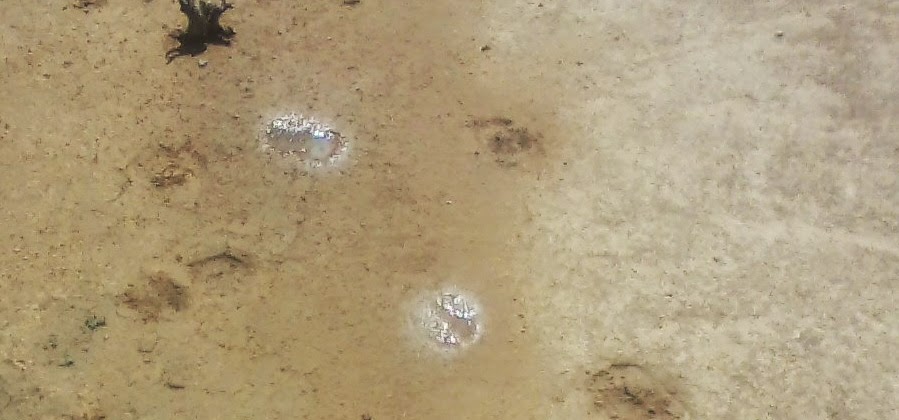
If you read my post on Why Climate Change scientists are clueless and were amazed at the amount of water which runs off after a rain, I underestimated it. Actually I grossly underestimated it as the following picture illustrates.


 How much more water would have gone into this ground if cattle were being run as a herd instead of being scattered out? The picture below would have had hundreds of tracks to fill with water instead of just two, which would have captured the water instead of letting it run away.


Tuesday, September 24, 2013

Innovative Fence Idea for Cell Grazing

Anyone who has ever ran more than two bulls is familiar with how much fence a couple of bulls can tear out. While at the Ganaderia Valle Colombia ranch in Mexico last week, Octavio Bermudez showed me how they keep the bulls from tearing up the fences at the cell centers. It is a slick method that could be used in other areas.


Tuesday, January 1, 2013

The Value of Holistic Herding

Many people look at what I am doing with holistic herding don't see the value. The first misconception that most people have is that, on their ranch, it would be impossible to do. The owners of the cattle I am currently herding once thought that as well. I first presented the idea of combining their cattle into one herd five and keep them moving years ago. Their reaction was "It is impossible to do" in this area. Now that they have been forced by drought (less than 10 inches total over three years) to lease pasture and have their cattle herded on the Circle Ranch  they are totally sold on the idea.

The benefits of holistic herding are:
  1. You know where your cattle are 
  2. You know what the condition of your cattle are
  3. You can gather your cattle in one day, without hiring day help
  4. Cattle actually do better in a herd situations than in small groups
  5. Take advantage of grazing areas cattle don't normally graze
  6. Concentrating the cattle and moving them concentrates manure and herd effect, which in turn helps build soil and increases both the amount and diversity of forage while improving hydrology of the land
  7. By increasing forage and areas you can graze increases your ability to either run more cattle or lease grass for yearlings.
  8. Reduces the amount of infrastructure to maintain in order to keep the cattle watered
  9. Reduces overall fuel, maintenance and labor costs.
  10. Reduces the amount of water needed

 Numbers eight and nine are hard for people to wrap their minds their minds around. Using the Circle ranch as an example, this is easy to explain. There are an average of five water points per pasture. In a herding situation, it is possible (and preferable) to water the herd at a single water point. By placing a single water point with covered storage in each pasture the Circle ranch would reduce the amount of driving to check water by as much as 80% (The costs implementing this could be offset by selling your now defunct drinkers)

How can it reduce the amount of water you need? A five foot diameter drinker has an annual evaporation rate of 750 gallons per drinker meaning that each of the pastures would require 3,000 less water per year or 51,000 gallons less water for the whole year (not counting the 1,000,000 lost in evaporation in the existing uncovered storage tanks ). How much would this reduce your ranch's electric and fuel bills in a year?

Once a person get past the excuse of not being able to herd holistically, there is no reason not to do it.

If you appreciate the free information you get from this blog, you will also enjoy the books and e-books I have on available on Amazon from my company website!


Tuesday, December 20, 2011

Low Stress Cattle Handling/Horsemanship Clinics


You cannot substitute articles and videos on reduced stress cattle handling procedures for real time, hands on experience to become proficient at handling cattle. Few of these articles and videos address the differences involved between handling cattle on foot or on a horse. Fewer still describe how, by simply changing the angle of your horse's body in respect to the cow, you can control the cow's speed and direction.

For a person handling cattle horseback on a ranch, or riding pens in a feedlot, you cannot learn how to handle cattle in a reduced stress manner without including horsemanship. Low stress cattle handling is synonymous with good horsemanship, you can't have one without the other. While those teaching low stress cattle handling on foot concentrate on reading cattle and making small corrections to keep things going, many of those teaching it from horseback are still doing many of the same old things. Keeping a horse parallel to a cow, beating it to the fence and working, prey/predator relationship, and training cattle to drive.

The word natural is over used and often misconstrued. The way your cattle act right now is only their natural reaction to what you are doing. The key to low stress cattle handling is to do things in a manner which naturally gets cattle to doing what we want in a calm manner.

If we are driving a cow and keeping our horse parallel to the cow and decide we need to turn it, we start putting pressure on their eye to get them to turn away from us. When we do this we turn our horse towards the cow and they speed up and try go around us. We blame the cow for speeding up and trying to go around us, but we are the one who turned on that switch in the cow to get that reaction.

In the same situation if we are tracking the cow with a slight amount of lateral movement on our horse we can actually ask the cow to turn by taking pressure off the cow. We do this by asking our horse to speed up slightly while moving laterally away from the cow. When we do this, we are taking away both the instinct of the cow to speed up and to go around us. Instead the cow feels as if its opportunity to go around us is taken away. At this point, rather than being excited and wanting to get around us, the cow's reaction is to turn slowly (without stress) away from us and in the direction we want.

In order to take advantage of the above natural instinct of cattle, we need to develop our horsemanship to a higher level. At times we can slow a cow by simply changing the angle of our horse in relationship to a cow. Essentially, the better our horsemanship is, the more we can master low stress cattle handling. This isn't to say our horses have to be perfect, as there is no true perfection. However if we master our horsemanship enough we can take advantage of methods to handle cattle with lower amounts of stress, not only on the cattle, but on our horses and ultimately on ourselves. The easier you make things on the cow, the easier it is on your horse, and the easier it is on you.

The answer to the conundrum of how to learn both the horsemanship techniques and the lower stress reactions of cattle is to learn them both at the same time. After years of thought on the matter I have designed a clinic program which addresses both the horsemanship and low stress instincts of cattle. As learning all of this is intensive, hands on clinic sizes will be limited to a total of seven participants, including crew or owners of sponsoring ranches. To learn more of my methods and all these clinics cover visit my main website.

I am now accepting host ranches for 2012 clinics. If you are going to be running yearlings, coinciding a clinic when you receive cattle, they will be calm and easy to handle when you turn them out with no additional labor costs. If you are running an AI breeding program I can also include training on how and when to pen your cattle for minimum stress and optimum conception. If you would like to host a clinic, email me me and we will make arrangements.

Sunday, April 3, 2011

The Power of "I Can't"

"It doesn't matter if you say you can, or you say you can't, you're right."
Many years ago I read the above quote, and it stuck with me. I don't remember who the quote is attributed to, but the simple wisdom of it has stuck with me through the decades.This self fulfilling prophecy really applies when you are considering different management techniques.

In drought conditions like much of the southwest is currently under, ranchers are culling herds deep to save grass. When you mention following an intensive, rotational grazing program the first thing out of their mouth is usually "I can't." This is of course followed by a myriad or "reasons" as to why it will not work on their ranch. The "reasons" range from water systems to how rough their ranch is, or how much brush, to their kind of cattle.

This brings me to my own saying. The only difference between a really good reason, and a poor excuse, is if you are listening to,  or telling it.  The "reasons" you give after spouting off the phrase "I can't" are only the excuses you give for not trying methods which may keep you from reducing your herd in a drought. When the first reaction is "I can't" you are not thinking of the positive possibilities, but the things which will only hold you back.

Conversely,  a person who says or thinks "I can" when approached with a new method to improve their situation will find a way to get it done. Again, this is a self fulfilling prophecy. When you say "I can" you are going to learn all you can about the new method so you can implement it for your situation.

The most efficient and effective way to manage your grazing at anytime is by herding your cattle through a holistic, intensive rotational program. You may need to make some changes in your water system, but for the most part the changes are rather simple, and relatively inexpensive for the benefits received. It will allow you to utilize grass more effectively, and in many cases allow you to graze areas of your ranch that usually aren't grazed at all. When the rains do come, this method will promote faster growth of grass, especially in tsabosa flats where the grass has become gray and matted.

Training your cattle to graze as a tight knit herd is simple. It is all a matter of whether you say "I can" or "I can't." If you want to keep your cow numbers up in this combination of drought and high prices, it may benefit you to adopt the "I can" philosophy!

Wednesday, March 30, 2011

Grass fed vs Grain Fed

There is a lot of debate on grass fed vs grain fed beef. It has dawned on me, that while everyone is posting their "facts" on the issue, that some very important information is being ignored. That information happens to be the yield grades being compared and the genetics which results in them.


When comparing the health differences, are researchers are comparing A yield grade 1 or yield grade 4 against the grass fed beef? In comparing the time to finish, are they comparing a grass fed steer which would finish on grain at a grade 4 against a grain fed steer which is finishing at a grade 1? 

A yield grade 1will have marbling, but much less extra fat than a yield grade 4 making the yield grade 1 a healthier product. Cattle finishing at a yield grade 4 generally have genetics which take longer to get marbling. This means that the "facts" in the debate can be misconstrued by researchers stacking the data by comparing against  different genetic types.

You want to stack the data to show how much healthier grass fed beef is over grain fed? Compare and Angus grass finished carcass against a large , fatty, yield grade 4 carcass. Want to stack the data showing how more efficient feeding grain is? Compare times to finish that animal producing the yield grade 4 carcass against the Angus steer finished on grain.

When gaining information between feeding methods, unless the genetics are taken into consideration, the results will not be accurate. Either side of the grass fed vs grain fed debate can use genetic differences in stacking the data in their favor. Until such time as there is a study comparing cattle with the same genetic tendencies towards marbling and body fat, neither side of the debate can give an accurate report to the consumer about efficiency or health.

Sunday, March 20, 2011

Reducing Input Expenses

In my last two posts, I discussed how much money you can be throwing away through poor cattle handling procedures and the true worth of your cattle after inflation is taken into consideration. While changing your cattle handling methods is an easy fix, trying to cut other inputs can seem to be insurmountable. However it can be easier than you can imagine.

Labor

If you have more than one full time employee for every thousand head of cows, or two thousand head of yearlings, you are over staffed. If you practice reduced stress cattle handling methods, and get through your cattle once or twice a week, the only time you should need extra help is when you are branding, weaning, shipping, or preconditioning.

Fuel Mechanical Maintenance

Nearly everyone spends more time in their pickup or on four wheelers than they do a horse. In many cases (especially if your ranch is in rough country) you really can't go any faster in a pickup than you can on a horse. Even if your roads are in good enough shape to go faster, why burn the fuel and tear up an expensive truck or ATV? I recently talked with one rancher who runs 1,500 pairs, plus a few hundred yearling heifers. He is running three employees and burns up over 1,000 gallons of gas and diesel each month in three pickups checking waterlines. That is an expense of nearly $4,000 in fuel before you figure in wear and tear on the trucks, flat tires and an extra full time employee.

I have run 2,200 yearlings plus an additional 150 pairs on 50,000 acres with no help and burned less than 45 gallons of fuel a month (with the exception of running to town for mineral or other supplies every other month.) The amount of fuel NOT burned amounts to 820 gallons a month. At $3.40 gas this amounts a reduction in input amounts of over $30,000 a year in fuel expenses alone.

Your wheels are turning, and you are thinking of all of the longer hours you will be putting in without your pickup or ATV. When running the above ranch, I ran the waterlines on a motorcycle Saturday morning and was off the ranch by noon. I would do a quick run on Monday morning just to make sure there were no new leaks. During the week, I was seldom home later than 5 or 5:30.

Additional Benefits
The first benefit is one you may not have thought of, your health and stress level. You, or your employee will remain healthier, both physically and emotionally, riding a horse than bouncing around in a pickup. Second, your cattle see you and will be calmer when you go to gather. This also means you see your cattle and know where they are, reducing or eliminating going back out to gather remnants at shipping time. If you plan your riding carefully, you will be checking your fences regularly and keep them in a better state of repair.

Direct Cattle Management
As I have pointed out before, using reduced stress cattle handling methods can increase ADG's with no added input. If you are running pairs, time your calving season to coincide with green grass. If you are in an area of cold and snow, this can cut your feed bill by two-thirds. You can either sell your excess hay or adjust your herd size to make up for the difference. Once again, this goes with the principle of reducing inputs while increasing income.

If you have any questions, feel free to leave a comment or email me.

Wednesday, March 16, 2011

Adjusting Today's Prices

Nearly everyone is happy about record high cattle prices. A lot of investors are looking at cattle as a "good investment" right now. However when you really look at input costs, you are receiving less for calves today than you were in the late 1970's

In 1979, I worked for a rancher who sold his calves for $125cwt. At the time, a new four wheel drive pickup was about $10,000 and a "high paid" cowboy made $500 a month and beef. Day work was expensive at $50 a day. Hay was roughly $45 a ton and gas was well under $2 per gallon.

Today's calves are bringing roughly $58 per cwt more, less than a 50% increase. Many cowboys are now starting out at $1,500 a month, or three times higher. Day labor has doubled at $100 a day. That four wheel drive pickup now costs $40,000, or four times as much. Hay costs over a $100 a ton (more than double) and gas is getting close to $4 a gallon and in many places, diesel is already over $4 a gallon (again, doubled). This does not take into account not only higher land prices, but higher property taxes as well. This means, after figuring input costs, your cattle are actually worth less than they were in 1979. If cattle were even keeping up with labor costs, today's calves should be bringing $3.75 cwt.

I can think of a number of things that 90% of cattle operations today could do to lower input costs. Most of these ranches could do to increase stocking capacity and the total pounds of cattle shipped from their ranch while lowering input costs. What are you doing to increase the efficiency of your cattle operation without increasing your input costs?

Saturday, March 5, 2011

Can You Afford To Burn Money?

I know of very few people who can afford to burn hundred dollar bills ten at a time, but many ranches tend to do just that every time they work cattle. This seems to be especially true on desert ranches where time is spent, not in the cattle, but constantly checking waterlines.

This past week I day worked on a local ranch which I've worked on before. Cattle are scattered out in groups of a hundred to two hundred per pasture, with the average pasture size around two thousand acres. If the cattle were ridden through even once a week, and handled with reduced stress methods one person could gather the cattle into the pens with no help, and a crew of four or five could get done with the sorting, branding, vaccinating and castrating fairly easily.

As these cattle only see people horseback when they are going to the pens to get worked, they are not only trotty, they have no intention of going into the pens. Since it is a known "fact" that the cattle are going to be hard to handle the crew grows to nine people, or an extra four or five hundred dollars a day.

Finding cowboys to work for day wages is hard. Finding cowboys that work for day wages who also work cattle in a reduced stress manner is next to impossible. As a result, when the cattle start getting leery of the pens, rather than back off and keep them quiet, the charge is on to get them into the pens as fast as possible. The pressured cattle wind up running off and in the ensuing stampede, calves have more stress related shrink, which winds up in higher than necessary morbidity and mortality rates. It also results in having to go back out to the pasture and roping calves that got away. At today's cattle prices this is costing in the neighborhood of thirty dollars per calf, or burning thirty one hundred dollar bills for every hundred calves you wean.

This week the ranch I worked on, between having to hire extra help, and their methods basically burned two hundred and five, one hundred dollar bills. If this isn't burning enough money, the cattle we worked this week is only one third of their herd, so between weaning the three groups, they are burning six hundred and fifteen of those one hundred dollar bills a year on weaning alone. Add a third that much shrink loss during branding and you are looking at over eighty thousand dollars a year going up in smoke.
Even including all related expenses, paying a cowboy thirty thousand dollars a year would save this ranch a minimum of forty thousand dollars a year. However the mentality seems to be that if a person is horseback in the cattle they are not "getting anything accomplished."

If you are tired of burning hundred dollar bills, and would like to learn more about reduced stress cattle handling, click here.

Wednesday, February 16, 2011

Results of Viral Ag Experiment

As some of you will remember I wanted to try trending @4H through the ag related cowboy gathering Texas Crossroads. This experiment to see if we could consciously trend an agriculture related event on twitter, but if it was possible for the different factions of agriculture to band together and have a louder voice.

We may be able to blame part of it on the weather and the rolling blackouts around much of the country, but only a small part of it. How can we explain that out of nearly 200 tweets, this experiment received only 20 RT's and of those 20, only five of them came from the several hundred that knew about this experiment ahead of time. Of the five, three of them were from a high school student who is interested in agriculture. The remaining RT's I made myself from my other Twitter account.

As I have mentioned before, we are a minuscule part of the population. Compared to the people and organizations dispensing negative and often false information about agriculture we are like a whisper in the wind. We cannot afford to be fragmented and expect to reach the general consumer in enough numbers to really make an impact.

If we don't find a way to band together and get our voices heard, the Agricultural industry in this country will go the same way as the steel mills, textile mills, and auto factories. A big step in this direction is already being taken with the USFS proposal to sell off all of its 193,000,000 acres and yet barely a whisper from people in agriculture.

Friday, February 11, 2011

US Forest Service to Sell off 193 Million Acres

The National Forest Service has announced plans to sell off its 193,000,000 acres of federally owned land. Government attorneys have argued that precedence for federal ownership of land has been set, showing the federal government has the authority over these lands. We can show that the precedence used to prove the legality of federally owned lands was flawed by asking one simple question:

Why did the federal government adhere to the stipulations of Article 17 under the Powers of Congress in all statehood expansion east of the Mississippi River?

For those of you not familiar with this section of the Constitution, it says:

To exercise exclusive Legislation in all Cases whatsoever, over such District (not exceeding ten Miles square) as may, by Cession of particular States, and the acceptance of Congress, become the Seat of the Government of the United States, and to exercise like Authority over all Places purchased by the Consent of the Legislature of the State in which the Same shall be, for the Erection of Forts, Magazines, Arsenals, dock-Yards, and other needful Buildings;

The precedence set of allowing territories to become states and NOT withholding large tracts of land east of the Mississippi River would indicate that the federal government is NOT allowed to hold interest of large tracts of land within a state.

The fight needs to be taken to the federal government on a three pronged attack. First disprove that the precedences used to support the government's claims that federally owned lands are legal. Secondly it needs to be pointed out to the Supreme Court in (historical terms, not legal) that the founders of our country, and the drafters of the Constitution were trying to create a government which would not own large portions of the country. The third prong of attack is using someone who is versed in the English language at the time the Constitution was written to describe what the article means in today's language.

By approaching the matter in this way we can prove that the government was acting beyond its authority when it withheld lands from the territories when granting statehood. That precedence used showing the federal government has the authority to control multi-use or recreational lands was false. It will also show that the intent of Article 17 in the Powers of Congress section was purposely written to prevent federal ownership of land.

In actuality, this proposed sale could prove to be an opportunity. The attorney generals of every state having USFS or BLM controlled land should be banding together on this fight. These states should be suing to have all land held by the federal government, falling outside of Article 17, returned to possession of the states. This would allow states to receive the income now going to the federal government for grazing, mining,logging and National Parks.

If you would like to read exactly what the powers of Congress are, click here!

Wednesday, February 2, 2011

Trending @4H Tonight through Saturday

We are trying to make @4H the Texas Crossroads Cowboy Gathering held tonight through Saturday night trend on Twitter. Crossroads donates all proceeds to 4H and the Christian Homeless Shelter here in Van Horn Texas. If you want to help, follow, mention and RT @Texascrossroad on Twitter. You can view this event on the browser below or at http://www.texascrossroadscowboypoetry.org


Video chat rooms at Ustream