Showing posts with label Holistic Management. Show all posts

Sunday, November 27, 2016

Climate Change; Man Made or Assisted by Man?

Most of the debate around manmade climate change revolves around whether or not the activities of man are responsible for climate change. It would seem the whole discussion needs to be reframed to look at man assisted climate change. We also need to re-examine the presumed man assisted causes, as well as differentiate, symptoms, causes and ways to minimize, and in some cases reverse the symptoms.

For some reason most of those researching climate change (in any form) are concentrating on greenhouse gasses and carbon dioxide levels. The "solutions" rest on things like regulating emissions by prohibition, trading "carbon credits" or taxation. Even causes stemming from land use seemingly concentrate on more gasses, with no thought to the condition of the land contributing to either rising oceans. It seems as if little or no thought is given to the conditions of the earth's surface in contributing to warming, changing weather patterns, contributing to flooding,  nor to rising ocean levels.

The possibility of regenerating grasslands has been largely ignored,  even though it reduces heat reflected into the atmosphere, captures carbon dioxide from the atmosphere, returns rainfall to aquifers, while increasing wildlife habitat and providing animal protein for human consumption.

Desertification of land is looked at as a symptom of warming, when it is actually a symptom of misuse, while at the same time, a cause of both atmospheric warming, and rising oceans. Completely ignored is just how fast desertification has happened in some places.

 To keep historical perspective, lets look at history in the terms of lifetimes. There has always been a few people living over 100 years. This would mean that, by cherry picking the right people, it has only been 20 lifetimes since Jesus Christ walked the earth. On a more personal level, my Great Great Grandmother was alive at the time of the Civil War and died in 1963 when I was 9 years old. Between the beginning of her life, and my life of 60+ years, we have seen the vast grasslands of the southwest United States and northern Mexico become barren deserts.  There are actually ranchers alive today who remember harvesting native grass hay in areas which are now mainly brushy and bare ground. Just how much of a difference can this make in changing our climate?

To demonstrate just how much the lack of grass cover reflects heat back into the atmosphere, I checked the air temperature, then checked the temperature on a patch of grass, and also a path of bare ground.
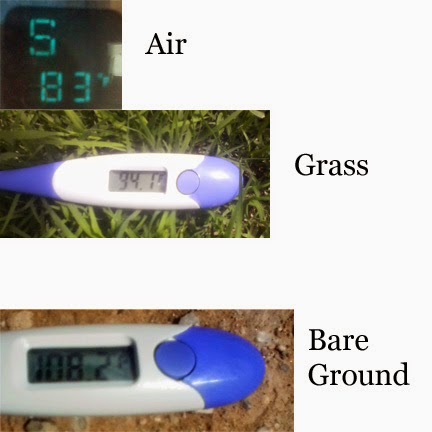
  Notice that the grass covered area is approximately eleven degrees warmer than the air while the bare ground is twenty five degrees warmer than air temperature.

A couple of hours later, the air temperature was 95 degrees. Rather than checking the temperature of the grassy spot first, we checked that same spot of bare ground, which was hot enough that it broke the thermometer. That would mean that the ground temperature was actually a minimum of 25 degrees warmer than the air temperature.

Adding to the heat absorption/reflection difference between bare ground and grass covered ground is the difference in water absorption. Rather than rain water absorbing into the ground (as it does when grasslands are intact,) precipitation actually starts running off with as little as 0.2 inches of rain. This means that a thunderstorm dropping an inch of water, loses half of aquifer recharge to run off. This run off goes into gullies, into small streams, river and lost into the ocean. This amounts to  13,577 gallons per acre run into the ocean from a one inch rain. In a drought like our most recent, where some areas only received 4 inches of precipitation, they lost 54,308 gallons of water per acre. There is roughly 293,000,000 acres of desertified ground between the southwestern United States and northern Mexico which have been degraded to this point. This results in 15,912,244,000,000 gallons of water returning to the oceans rather than recharging aquifers, in a year of severe drought. In a year of 10 inches (still just below normal of 11 to 12 inches of precipitation) we are looking at 135771.4 per acre (or 39,781,020,200,000 gallons for the region) flowing into the ocean rather than recharging aquifers. Take into consideration, this 39,781,020,200,000 gallons is only part of the water flowing back into the ocean rather than the ground on part of ONE continent. This isn't even taking into consideration of the addition of paved ground. 
 The first mile of asphalt paving was laid out in 1920 on Woodward Avenue, in Detroit Michigan.  Since then, asphalt and concrete paving has covered an estimated 29,000 square miles, or 18,560,000 acres. Taking into consideration that there are some roads in the country which the water ists in the bar ditch without emptying into a creek or river which eventually ends in the world's oceans, lets (for the sake of a conservative estimate) assume that only a third of our paved areas are draining directly into the ocean. That still leaves us with 6,186,666 acres of paved ground sending water into the oceans at a rate of 27154 gallons per inch of rain. This amounts to 16,7992,728,564 gallons running straight into the oceans per each inch of rain falling on our paved areas. In a drought year of only 6 inches of rain average across the country that comes up to an astounding 1,007,956,371,384 from our country alone from the addition of paved surfaces.

The combination of these two sources of water returning to the oceans rather than into the soil and replenishing aquifers comes to  a "mere" 5,658,029,305,640 gallons of water returning to the oceans from the United States and Mexico alone. Some will be quick to point out that a more accurate figure would be achieved by subtracting the acres of paved acres from the total of desertified areas, but this total would still be low when one figures out what has been left out of these figures.
The grasslands in the rest of the western half of the United States, while not considered to be desertified, have less than half their grass cover compared to the late 1800's, which is adding an a untold amount of water to the oceans. This is still not taking into account flood control systems, like the levee system on the Mississippi River which are adding more water rather than allowing it to spread out and fertilize the delta lands.  The total would certainly be result in an increase to  the 5,658,029,305,640 gallons in these figures. The worldwide total of water running back into the oceans rather than aquifers would dwarf what runs off from North America... Yet this is seemingly not taken into consideration by scientists studying climate change and rising oceans. A very few scientists are actually looking at the either the warming affects of these two things, nor the ramifications of reversing desertification through regenerative grazing.

In order for science to really get a grip on solving the problems of climate change, they need to ask a few more questions.

  1. How much are precipitation flows being affected by the millions of acres of desertified land and the heat rising from them? 
  2. How would the precipitation patterns change if grasslands were regenerated worldwide?
  3. How much is atmospheric temperature being affected by the combination of paved surfaces and desertified land?
  4. How much atmospheric carbon in the atmosphere would be sequestered by regenerating grasslands worldwide? 
  5. How much water would flow into aquifers rather than the oceans if grasslands were to be restored?
  6.  How much more animal protein could be added to the food supply by the increase in animals needed to restore and maintain grasslands through the proper grazing methods needed to restore them?
Until the scientific community starts acknowledging these things, and using them in computer models, how accurate can they really be? How can these scientists convince climate change deniers unless they acknowledge and differentiate between those events occurring naturally which change change climate, and the manmade things which assist the acceleration of changing climate? Until such time as these questions are addressed, and so long as the majority of the "solutions" are based on taxation, fines, and other financially inert things such as  trading carbon credits, a true solution will not be found.


Wednesday, August 21, 2013

Forage Improvement Results From Holistic Herding

Back in October of 2012 I began a project of  using low stress stockmanship to herd 460 cows through a 32000 acre grazing plan. During the course of this grazing season, I did a few experiments to see how much ( if any) increase in forage I could get in areas where cattle normally don't graze. One area was four miles from the water source for the 280 head I placed for one day. I placed approximately 180 head to graze up a draw to the top of a long ridge, and let them keep going back on their own. There was another area which was sub-soiled with the Yeoman Plow just before it was grazed.

All of these areas (and more) improved, some with dramatic results. You can see it for yourself in this video!


Saturday, August 10, 2013

Releasing The Flerd

I have been asked why this particular combination  of animals, and why combine them at all. The reason behind these species is that they just happen to be on this ranch. There are also getting to be more ranches which deal in exotic species rather than cattle or other livestock normally raised on ranches. While the numbers are not high enough to get a lot of animal impact (especially when the pastures are 1,000 acres or larger.) The intent of this experiment is to show that flerds consisting of exotic animals (or a mix of exotic and "normal" livestock) can be herded through a holistic grazing plan. The animal impact will be a bit different as they will spread out more with each species in their own group, but will still have control on which pastures they will graze and when they will graze them.

This week the burros were trapped in a pen and added to the flerd. I put the burros in a pen by themselves and just sat there for a bit, Then I positioned myself so the burros would go past me. The first few times they went pretty fast. By the fourth or fifth time they figured out they weren't being chased and slowed down to a walk. I worked them around me a few times and when they got to the point I could stop them easily, I turned them out with the rest of the flerd.

By Friday everything in the pens was getting along fairly well. On Friday I turned the flerd out into a small trap of several hundred acres. I held the burros back and let them out of the pen last, rode past them to the longhorns in the lead, and turned them back to have everything grazing across the west side of the trap. Once I got them headed the way I wanted I went back and bumped the burros a little farther from the gate, stopped them and rode off. I had a bad video week (capped off by closing the lens cover  as I was letting them out) so I don't have any video this week. On Sunday I will be moving them around the trap, and turning them into an adjacent pasture on Monday. It will be interesting to see how far apart the various species stay from each other, and how putting them together and moving them as a group will work (or if I'll have to move each species as a separate group.) Hopefully I'll have some decent video next week, but in the meantime, enjoy these pictures.

 The above picture shows just how much the burros have settled down. When they were first turned in they refused to allow a lama or alpaca to get close to them.
This is definitely a mismatch, but this alpaca doesn't seem to notice the size difference.

     Here is the flerd after I turned them out. The burros had stopped just outside the gate and I moved them about fifty yards then stopped them. It will be interesting to see how well everything moves together when I turn them out in the pasture this week. Hopefully I'll get some usable video!


Tuesday, July 16, 2013

Low Stress Roping

When most people think of roping, they think of it as it is done in the arena. Run hard, throw a loop and jerk the animal around so another person can rope the heels and stretch an animal out as fast as they can. Cowboys often feel that this is the only, or at least the fastest way to get cattle doctored in the pasture. Just like low stress stockmanship, the original Vaquero style of roping appears to be slow, but is actually faster and more efficient in the long run.

A good example was one ranch I was on where we were having a scours/ pneumonia wreck.  Between two of us, we were doctoring up to 160 calves a day, or 80 to 90 calves apiece everyday. By using the old style big loop style that people consider to be "fancy," I was able to accomplish it without having to change horses at noon everyday. My cattle stayed calm and easy to handle. At the same time the other guy (who constantly cussed me for "packing a clothesline") not only had to change horses everyday at noon, but the cattle he was doctoring on would take off at a trot as soon as he rode into view.

There are several secrets to why big loop roping are low stress.
  1. Variety of available loops. Rather than being limited to either a conventional run them down head or heel loop, a person will have four or five varieties of head and heel loops to fit different scenarios.
  2. This variety of loops, combined with low stress handling methods allows a person to do the vast majority of their roping at a walk or trot. 
  3. Allows ropers to handle cattle without constantly choking them because of the style of hondos used.


As you can see in the picture to the right, this style of hondo will give an animal a chance to breath when the rope is slackened.  While allowing an animal to have slack on the end of the rope may sound strange, in actuality is allows the animal to remain calm. This helps in two ways. If a person is doctoring cattle too large to wrestle to the ground, it allows you to trot a couple of circles around the animal (having them step over the rope with their front feet), basically heeling them so you can pull them over with minimal effort. If two people are doctoring, this allows the heeler to throw their loop and get the animal down for treatment with minimal stress on the cow and minimal effort on their horse. Combined, this method allows you to doctor more cattle on fewer horses while keeping your cattle from getting wild. 

Many people are reluctant to try the big loop style of roping because they are afraid of getting tangled up in the "extra" rope. The best way to learn is to practice on a roping dummy, then rope cattle using a breakaway hondo. If you do something wrong, instead of being tied to a cow, the hondo will release the rope. Once you get to the point of being able to stop your cattle with the breakaway hondo like in the video below, you are ready to start roping for real. Between the variety of loops and distance they can be thrown, you will be able to doctor more cattle in a day, with less effort than you ever thought possible.


Tuesday, June 18, 2013

Cowman Dressage

While "Cowboy Dressage" has turned into an arena event with no cattle, there is a reason behind doing dressage movements when working cattle. Holistic educator and low stress cattle handling clinician Guy Glosson has a saying, "You never get a second chance at a first approach."

While it is easy to make a mistake when approaching a cow to sort it off from the others, the real problem is not in the mistake, but in how we recover from it. In order to make a quick recovery, in a way that keeps the cattle calm. Having a horse that knows a little "Cowman Dressage" can go a long way in adjusting those first approach mistakes.

Handling cattle and riding a horse are two things which consist of a large amount of "intuitive feel." In order to be really good at either one, the more feel you have the better you will be. This feel is something most of us have to work at. We don't realize just how sensitive the the feel between us and the horses we ride can be. For those of us who are working cattle horseback, we often feel we don't have the time to work on it, but the fact is we pass up opportunities to work on our feel and focus nearly every time we get on a horse.

Day one of my clinics focus on developing feel and how to take advantage of our natural surroundings to build dressage movements in our horses. While we are doing this, we are also discussing cattle behavior and when to use different movements. Day two is applying these movements on cattle. These clinics are held in the pasture and limited to eight riders.
For more information on clinic dates, or to host a clinic, visit my main website.

Thursday, March 14, 2013

Supporting Kids In Agriculture!

   As the agriculture gets older, we are having fewer and fewer young people wanting to make a career out of farming and ranching. This means it is up to the old codgers to do what we can to help those few kids interested in an agricultural career to do what we can to help them out.

    One way we can do this is by holding and sponsoring events which support youth in agriculture. On Saturday, March 30th just such an event will be taking place. The SWRRA winter series finals, and Crossroads Cowboy Gathering will have the Crossroads Finals Show and Dance with all proceeds going straight to the Benson, Arizona FFA. Setting an example for the rest of us involved in agriculture, Baxter Black will be donating his time to perform during this event. The community of Benson has shown great support for this event as well. Even the agritainers coming to this event are supporting Benson's kids in agriculture by donating their time to provide music for the dance.

For more information on this event, visit our web page. If you can't make it, and would like to support the agritainers donating their time, you can buy their cd's on the Crossroads Agritainer's Sales Page. We need to remember that the children are not our future, but what we do now, contributes to theirs!

Thursday, January 10, 2013

If Bison Chased Horses & Cattle Chased Rabbits

Why are equines the only grazing animal which seemingly enjoys chasing and dominating other grazing animals? This is a question which has baffled me for years (actually decades) yet it is an important aspect of animal behavior that people seem to miss. I bring this up because of a recent discussion on bison.
I know there are a lot of people out there who are going to counter with “My bison charge anyone on horseback,” but the simple fact is, they aren't. If they were, cutting horse trainers would not risk using bison to tune up show horses worth tens, if not hundreds of thousand of dollars. So why does a herd of bison “charge” people who are horseback? Curiosity.

When confronted with something new, grazing animals are generally either afraid or curious. If they are afraid, they will watch cautiously or flee. If they are curious they will go see what it is. If one or two of a group of grazing animals get curious about something and start running towards it, the whole herd will follow.

In the case of a horseman being “charged” by a bison herd, it is a case of a few of the animals being curious enough about something to run over to check it. The rest of the herd follows. The first thing that pops into the rider's mind is panic, which transfers immediately to the horse. Horse and rider vacate the premises with the bison following trying to see what the heck that strange thing is.

Cattle will do the same thing. A person walking across a field full of yearling heifers who are not used to seeing a person afoot, will come stampeding right up to the person and if the person runs, they will keep following. If the person stops, so do the heifers, but they may come close enough to them to sniff them.
Once I had a steer in a little group of five hundred that was insanely curious about rabbits. One morning all five hundred were running around the pivot, as a herd. I could see noting they were chasing so I rode to that pivot to check it out. When I got there they were all stopped in a big circle. When I got to the middle, the one steer was standing on a jack rabbit's leg while he was licking it. Other than standing on a leg to pin it down the steer was not doing anything aggressive towards the rabbit. On the contrary, he was grooming it!
This was not a one time affair with this steer. In the several months I had this group of cattle, I had to move them back and forth across some desert ground to some remote pivots. This steer was naturally in the lead, and whenever a rabbit jumped up in front of him, he'd take off chasing the rabbit.

There is a similarity between the rabbits being chased by that steer, and riders being chased by bison. Instead of thinking about what was really going on, they both ran like heck to get out of the way. All the bison are wanting to do is check you out, and all that steer was wanting to do was give the rabbit a bath.
The point to all of this is that bison can be worked horseback. You have to put some thought into it and acclimate them first. After all, if bison choused horses, Indians would have ridden bison and lived in horse hide teepee. 

Services I offer                                               Humor, Horsemanship & Cookbooks I've written

Tuesday, January 1, 2013

The Value of Holistic Herding

Many people look at what I am doing with holistic herding don't see the value. The first misconception that most people have is that, on their ranch, it would be impossible to do. The owners of the cattle I am currently herding once thought that as well. I first presented the idea of combining their cattle into one herd five and keep them moving years ago. Their reaction was "It is impossible to do" in this area. Now that they have been forced by drought (less than 10 inches total over three years) to lease pasture and have their cattle herded on the Circle Ranch  they are totally sold on the idea.

The benefits of holistic herding are:
  1. You know where your cattle are 
  2. You know what the condition of your cattle are
  3. You can gather your cattle in one day, without hiring day help
  4. Cattle actually do better in a herd situations than in small groups
  5. Take advantage of grazing areas cattle don't normally graze
  6. Concentrating the cattle and moving them concentrates manure and herd effect, which in turn helps build soil and increases both the amount and diversity of forage while improving hydrology of the land
  7. By increasing forage and areas you can graze increases your ability to either run more cattle or lease grass for yearlings.
  8. Reduces the amount of infrastructure to maintain in order to keep the cattle watered
  9. Reduces overall fuel, maintenance and labor costs.
  10. Reduces the amount of water needed

 Numbers eight and nine are hard for people to wrap their minds their minds around. Using the Circle ranch as an example, this is easy to explain. There are an average of five water points per pasture. In a herding situation, it is possible (and preferable) to water the herd at a single water point. By placing a single water point with covered storage in each pasture the Circle ranch would reduce the amount of driving to check water by as much as 80% (The costs implementing this could be offset by selling your now defunct drinkers)

How can it reduce the amount of water you need? A five foot diameter drinker has an annual evaporation rate of 750 gallons per drinker meaning that each of the pastures would require 3,000 less water per year or 51,000 gallons less water for the whole year (not counting the 1,000,000 lost in evaporation in the existing uncovered storage tanks ). How much would this reduce your ranch's electric and fuel bills in a year?

Once a person get past the excuse of not being able to herd holistically, there is no reason not to do it.

If you appreciate the free information you get from this blog, you will also enjoy the books and e-books I have on available on Amazon from my company website!