I've always loved acquiring knowledge, but learned at an early age that "facts" spread by research scientists and schools are not always true. Unfortunately, in order to succeed in school, and later in life, you aren't allowed to question the facts. You are indoctrinated to believe that any peer reviewed research is correct...but
You may have read the reading right, but are you sure the one who wrote the reading, wrote the reading right?
When I was in 8th grade there was a picture of a Peregrine falcon on the front page of the paper with a headline declaring that there were only four such birds left in the state of California. This surprised me as we had four of them flying around our house, and I was unaware that anyone had been in the neighborhood to count them. Curious, I called an uncle (who was a federal game warden) who informed me that I was mistaken, and the only such birds in the state were nearly 200 miles away, on the coast. A few weeks later he was visiting and admitted that the birds we had been watching were indeed Peregrine Falcons. The population of this bird had just increased by 100%, yet no public mention was made. Odds are, there were even more of them.
You may have read the reading right, but are you sure the one who wrote the reading, wrote the reading right?
The next year, the first chapter of my biology book stated that browsing animals preferred brush and twigs while cattle preferred grasses and legumes. Naturally (for me) I questioned the teacher about it the next day, because if this were true, deer wouldn't some out at night to graze on lawns and alfalfa fields while cows wouldn't be browsing on acorns, pine-nuts and brush. Of course the teacher corrected me and I received a "D" on my first test because my answers (based on personal observation) didn't agree with what was in the textbook.
You may have read the reading right, but are you sure the one who wrote the reading, wrote the reading right?
The conundrum of scientific "fact" not matching up to observations didn't stop there. A biologist who allegedly conducted a count of deer and elk on a ranch where I worked, concluded that there were no deer or elk on the ranch. I offered to show him two herds of does totaling over 70 head (not including fawns,) at least a dozen mature bucks, not to mention a couple of small elk herds. Once again, he filed his report and the lie became truth. This was a smaller scale than the "endangered" desert tortoise which removed cattle from grazing permits (although, 70 miles away, in Las Vegas, construction companies had crews following earth moving equipment rescuing said "endangered species" by the tens of thousands...
You may have read the reading right, but are you sure the one who wrote the reading, wrote the reading right?
Now we come to holistic/regenerative grazing. As soon as Alan Savory claimed cattle could be used to regenerate grasslands, academia rushed to disprove it. Although he and others reclaimed millions of acres using his, or similar methods, academia continued to "disprove" his methods, often publishing new "peer reviewed" studies which were basically compiling "evidence" from other studies. For at least the last 80 years, the science behind range management has been peer reviewed opinion that degrading range conditions were the result of over grazing, with no thought given to plants dying from being under grazed, or consideration to the biology of the soils supporting the flora of the range.
Finally in the last few years some scientists are breaking out of the mold and discovering that holistic/regenerative grazing not only works, but that the science behind it is directly tied to the symbiotic relationship plants have with the biology in the soil in which they grow. The science which, so many have base their grazing paradigms on was wrong... Science is dead....Long live science.
You may have read the reading right, but are you sure the one who wrote the reading, wrote the reading right?
Now we come to the current feedlot system of producing beef. Science claims that it is the most efficient model of beef production. These claims are based upon the fact we are producing more pounds of beef with fewer resources. Once again, science has the peer reviewed studies, complete with tons of data to "prove" they are right. On a limited basis, without consideration to lands reverting to desert and bare ground, they may be right. However to reverse desertification (which is happening from Mexico, through the United States and into Canada) we need more cattle on the land. By staying with the present model, we are only accelerating the problem, which in a larger sense, isn't efficient at all. Ranchers who have successfully implemented regenerative grazing by any of it's names have often quadrupled their stocking rates while nearly eliminating runoff from precipitation (not to mention recovering dry springs, creeks and seasonal rivers.)
You may have read the reading right, but are you sure the one who wrote the reading, wrote the reading right?
Who knows, perhaps I haven't written the reading right. Perhaps the range management science of the last 80 or so years, prescribing burning, herbicides and destocking have nothing to do with the spread of invasive plants, lowering ground water tables, and degradation of grass. But then again, someone once said that the definition of insanity was doing the same thing over and over and expecting different results.
For more information visit my website.
Showing posts with label #Savorygrasslandsmanagement. Show all posts
Showing posts with label #Savorygrasslandsmanagement. Show all posts
Saturday, October 20, 2018


Thursday, May 4, 2017
Instinctive Migratory Grazing (IMG) on the Chihuahua Desert
Last week I had the privilege to be part of a group visiting the Santa Maria Cattle Company in Chihuahua, Mexico. Owner Fernando Falomir was a student at my first low stress stockmanship school in Mexico, and has been practicing the methods for several years. His description of how they were practicing regenerative ranching on 10,000 acres with only 17 pastures was that the cattle "instinctively migrate around the pasture." His description finally gave me the name for what we accomplish when we reboot herd instinct in cattle. "Instinctive Migratory Grazing," or "IMG" for short. The training video to teach you the basics in achieving this kind of grazing results is available on Amazon.
The following video will show you just how amazing their results are.
The following video will show you just how amazing their results are.

Friday, January 27, 2017
Stockmanship 101 Now Availible on Amazon!
Thanks to those who supported the project, the English version of Stockmanship 101 (rebooting herd instinct) is now available on Amazon. This video was premiered at last week's school at Rancho Terrenates in Chihuahua, Mexico, where some students actually watched it a second time. It was also well received at a short seminar in Chihuahua City, Mexico where several students from my first school at Rancho De Las Damas were in attendance. Humbling to know that such a high percentage of those you teach are able to carry on the concepts when they get home!
Sunday, November 27, 2016
Climate Change; Man Made or Assisted by Man?
Most of the debate around manmade climate change revolves around whether or not the activities of man are responsible for climate change. It would seem the whole discussion needs to be reframed to look at man assisted climate change. We also need to re-examine the presumed man assisted causes, as well as differentiate, symptoms, causes and ways to minimize, and in some cases reverse the symptoms.
For some reason most of those researching climate change (in any form) are concentrating on greenhouse gasses and carbon dioxide levels. The "solutions" rest on things like regulating emissions by prohibition, trading "carbon credits" or taxation. Even causes stemming from land use seemingly concentrate on more gasses, with no thought to the condition of the land contributing to either rising oceans. It seems as if little or no thought is given to the conditions of the earth's surface in contributing to warming, changing weather patterns, contributing to flooding, nor to rising ocean levels.
The possibility of regenerating grasslands has been largely ignored, even though it reduces heat reflected into the atmosphere, captures carbon dioxide from the atmosphere, returns rainfall to aquifers, while increasing wildlife habitat and providing animal protein for human consumption.
Desertification of land is looked at as a symptom of warming, when it is actually a symptom of misuse, while at the same time, a cause of both atmospheric warming, and rising oceans. Completely ignored is just how fast desertification has happened in some places.
To keep historical perspective, lets look at history in the terms of lifetimes. There has always been a few people living over 100 years. This would mean that, by cherry picking the right people, it has only been 20 lifetimes since Jesus Christ walked the earth. On a more personal level, my Great Great Grandmother was alive at the time of the Civil War and died in 1963 when I was 9 years old. Between the beginning of her life, and my life of 60+ years, we have seen the vast grasslands of the southwest United States and northern Mexico become barren deserts. There are actually ranchers alive today who remember harvesting native grass hay in areas which are now mainly brushy and bare ground. Just how much of a difference can this make in changing our climate?
To demonstrate just how much the lack of grass cover reflects heat back into the atmosphere, I checked the air temperature, then checked the temperature on a patch of grass, and also a path of bare ground.
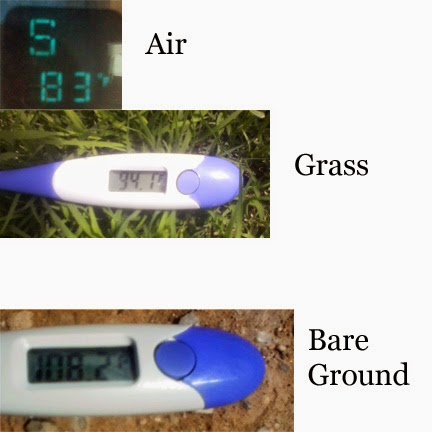 Notice that the grass covered area is approximately eleven degrees warmer than the air while the bare ground is twenty five degrees warmer than air temperature.
The possibility of regenerating grasslands has been largely ignored, even though it reduces heat reflected into the atmosphere, captures carbon dioxide from the atmosphere, returns rainfall to aquifers, while increasing wildlife habitat and providing animal protein for human consumption.
Desertification of land is looked at as a symptom of warming, when it is actually a symptom of misuse, while at the same time, a cause of both atmospheric warming, and rising oceans. Completely ignored is just how fast desertification has happened in some places.
To keep historical perspective, lets look at history in the terms of lifetimes. There has always been a few people living over 100 years. This would mean that, by cherry picking the right people, it has only been 20 lifetimes since Jesus Christ walked the earth. On a more personal level, my Great Great Grandmother was alive at the time of the Civil War and died in 1963 when I was 9 years old. Between the beginning of her life, and my life of 60+ years, we have seen the vast grasslands of the southwest United States and northern Mexico become barren deserts. There are actually ranchers alive today who remember harvesting native grass hay in areas which are now mainly brushy and bare ground. Just how much of a difference can this make in changing our climate?
To demonstrate just how much the lack of grass cover reflects heat back into the atmosphere, I checked the air temperature, then checked the temperature on a patch of grass, and also a path of bare ground.
A couple of hours later, the air temperature was 95 degrees. Rather than checking the temperature of the grassy spot first, we checked that same spot of bare ground, which was hot enough that it broke the thermometer. That would mean that the ground temperature was actually a minimum of 25 degrees warmer than the air temperature.
Adding to the heat absorption/reflection difference between bare ground and grass covered ground is the difference in water absorption. Rather than rain water absorbing into the ground (as it does when grasslands are intact,) precipitation actually starts running off with as little as 0.2 inches of rain. This means that a thunderstorm dropping an inch of water, loses half of aquifer recharge to run off. This run off goes into gullies, into small streams, river and lost into the ocean. This amounts to 13,577 gallons per acre run into the ocean from a one inch rain. In a drought like our most recent, where some areas only received 4 inches of precipitation, they lost 54,308 gallons of water per acre. There is roughly 293,000,000 acres of desertified ground between the southwestern United States and northern Mexico which have been degraded to this point. This results in 15,912,244,000,000 gallons of water returning to the oceans rather than recharging aquifers, in a year of severe drought. In a year of 10 inches (still just below normal of 11 to 12 inches of precipitation) we are looking at 135771.4 per acre (or 39,781,020,200,000 gallons for the region) flowing into the ocean rather than recharging aquifers. Take into consideration, this 39,781,020,200,000 gallons is only part of the water flowing back into the ocean rather than the ground on part of ONE continent. This isn't even taking into consideration of the addition of paved ground.
The first mile of asphalt paving was laid out in 1920 on Woodward Avenue, in Detroit Michigan. Since then, asphalt and concrete paving has covered an estimated 29,000 square miles, or 18,560,000 acres. Taking into consideration that there are some roads in the country which the water ists in the bar ditch without emptying into a creek or river which eventually ends in the world's oceans, lets (for the sake of a conservative estimate) assume that only a third of our paved areas are draining directly into the ocean. That still leaves us with 6,186,666 acres of paved ground sending water into the oceans at a rate of 27154 gallons per inch of rain. This amounts to 16,7992,728,564 gallons running straight into the oceans per each inch of rain falling on our paved areas. In a drought year of only 6 inches of rain average across the country that comes up to an astounding 1,007,956,371,384 from our country alone from the addition of paved surfaces.
The combination of these two sources of water returning to the oceans rather than into the soil and replenishing aquifers comes to a "mere" 5,658,029,305,640 gallons of water returning to the oceans from the United States and Mexico alone. Some will be quick to point out that a more accurate figure would be achieved by subtracting the acres of paved acres from the total of desertified areas, but this total would still be low when one figures out what has been left out of these figures.
The grasslands in the rest of the western half of the United States, while not considered to be desertified, have less than half their grass cover compared to the late 1800's, which is adding an a untold amount of water to the oceans. This is still not taking into account flood control systems, like the levee system on the Mississippi River which are adding more water rather than allowing it to spread out and fertilize the delta lands. The total would certainly be result in an increase to the 5,658,029,305,640 gallons in these figures. The worldwide total of water running back into the oceans rather than aquifers would dwarf what runs off from North America... Yet this is seemingly not taken into consideration by scientists studying climate change and rising oceans. A very few scientists are actually looking at the either the warming affects of these two things, nor the ramifications of reversing desertification through regenerative grazing.
In order for science to really get a grip on solving the problems of climate change, they need to ask a few more questions.
The first mile of asphalt paving was laid out in 1920 on Woodward Avenue, in Detroit Michigan. Since then, asphalt and concrete paving has covered an estimated 29,000 square miles, or 18,560,000 acres. Taking into consideration that there are some roads in the country which the water ists in the bar ditch without emptying into a creek or river which eventually ends in the world's oceans, lets (for the sake of a conservative estimate) assume that only a third of our paved areas are draining directly into the ocean. That still leaves us with 6,186,666 acres of paved ground sending water into the oceans at a rate of 27154 gallons per inch of rain. This amounts to 16,7992,728,564 gallons running straight into the oceans per each inch of rain falling on our paved areas. In a drought year of only 6 inches of rain average across the country that comes up to an astounding 1,007,956,371,384 from our country alone from the addition of paved surfaces.
The combination of these two sources of water returning to the oceans rather than into the soil and replenishing aquifers comes to a "mere" 5,658,029,305,640 gallons of water returning to the oceans from the United States and Mexico alone. Some will be quick to point out that a more accurate figure would be achieved by subtracting the acres of paved acres from the total of desertified areas, but this total would still be low when one figures out what has been left out of these figures.
The grasslands in the rest of the western half of the United States, while not considered to be desertified, have less than half their grass cover compared to the late 1800's, which is adding an a untold amount of water to the oceans. This is still not taking into account flood control systems, like the levee system on the Mississippi River which are adding more water rather than allowing it to spread out and fertilize the delta lands. The total would certainly be result in an increase to the 5,658,029,305,640 gallons in these figures. The worldwide total of water running back into the oceans rather than aquifers would dwarf what runs off from North America... Yet this is seemingly not taken into consideration by scientists studying climate change and rising oceans. A very few scientists are actually looking at the either the warming affects of these two things, nor the ramifications of reversing desertification through regenerative grazing.
In order for science to really get a grip on solving the problems of climate change, they need to ask a few more questions.
- How much are precipitation flows being affected by the millions of acres of desertified land and the heat rising from them?
- How would the precipitation patterns change if grasslands were regenerated worldwide?
- How much is atmospheric temperature being affected by the combination of paved surfaces and desertified land?
- How much atmospheric carbon in the atmosphere would be sequestered by regenerating grasslands worldwide?
- How much water would flow into aquifers rather than the oceans if grasslands were to be restored?
- How much more animal protein could be added to the food supply by the increase in animals needed to restore and maintain grasslands through the proper grazing methods needed to restore them?
Saturday, August 27, 2016
Fundraising For Drone Based Video
Using the right grazing management can bring back your grass to where it was 100 years ago. This is made easier using stockmanship methods which allow you to follow grazing plans without using fences.
Several of the ranchers in this video use are using the stockmanship techniques I taught them in regenerating these ranches as it allows them to concentrate their herds where it is nearly impossible to build fence.
Currently trying to raise money to produce a professionally filmed, drone based, video of these techniques on the Circle Ranch in Hudspeth county, Texas. In order to make the information available to as many as possible, there will be versions in both English and Spanish. Both versions will be available for free in segments on YouTube, as well as for sale on Amazon in all available formats.
A $30 donation will get you a copy of the cd when it is finished! Corporate and non-profits partnering with me on this video will be able to get as many as they want in either version at cost plus shipping, plus be acknowledged in the credits of the video. (please contact me direct for information on partnering with me on the video) https://www.gofundme.com/2et8s5as
Thursday, February 18, 2016
Improving The Value Of Your Ranch Without Increasing Taxes
IN many
areas, property taxes on rangeland are based on set amounts per acre,
rather than the actual value of the range. These two properties are
taxed at the same per acre rate despite the fact that the one on the top is more valuable for either grazing or wildlife habitat.


These
two pictures are from adjoining ranches, and only eight years
previously, these two properties were in identical condition. This
rangeland improvement was achieved without spiking, fertilizing,
irrigation, or mechanical methods. Even more amazing is the fact is
that for half the time of this improvement, there was a drought!
In
many instances this can be achieved with minimal adjustments to the
infrastructure so that after the first year. With prices for leased pasture, one can possibly get paid to improve range conditions, rather than spending money to
make improvements. Overall costs associated with infrastructure and labor with this pasture improvement method can be reduced even farther by implementing the proper stockmanship methods to allow for controlled grazing without using small paddocks.
For more information, visit Natural Cattle Handling or email me.
Friday, December 11, 2015
Funding Donations Demonstrates That Sports Entertainment More Important Than Agriculture
There is no doubt that there is a world wide disconnect between people and where their food comes from. This disconnect is nothing new. A prime example is the Pilgrims off of the Mayflower. In spite of living next to an ocean full of fish (not to mention clams, mussels, crabs, and lobsters exposed at low tide) and on a land with abundant wild game, they nearly starved to death. The reason? Virtually none of them had ever had to grow their own food.
Fifty years ago, roughly half the people in the United States were involved in agriculture. Today that figure is less than two percent. From all of the news stories condemning factory farms, GMO food crops, pesticides and herbicides,one may assume that the public is concerned about their food supply. However two different funding campaigns tell a different story.
The first campaign is one started on November 28, 2015. Team roper Jake Barnes was practicing in his arena in preparation for the National Finals Rodeo when his horse fell. The horse stepped on his head and Jake was rushed to the hospital. Within twenty four hours a GoFundMe account was set up for Jake's family. In only eleven days, this campaign received $125,000 out of the $150,000 goal, from four hundred fifty one people. That is an average of $277 per donation. By all accounts, Jake is one of the good guys, and the family probably needs some help at this time. However why is it that a sports figure like this receives more donations in less than two weeks than a family farm who has been put in dire straights by their own government and bank can raise in three weeks?
Jervoise Station, in Queensland, Australia is owned by Greg and Kerry Jonsson. Ahead of the curve, they changed their cattle operation to organic in 1979. In 2005 they purchased their own abattoir so they could insure that people buying their beef would have a totally healthy, chemical free product. The business was successful and growing.
Then in 2014, the government owned power company decided they required the property where the abattoir was on. The family was forced to part with their processing plant for less than they owed on it. Although the business had been thriving and growing prior to the government take over of their abattoir, the bank refused to work with them and declared their station to be insolvent. The bank eventually agreed to work with them to build a new abattoir on the station, but only if they can raise $250,000. Without this money the family stands to lose their beloved Jervoise Station and the fifty years of blood, sweat, and tears they have poured into it.
In contrast to the donation campaign for Jake Barnes, their campaign has only raised $19,020 over the last month. The donations averaged $98 from only one hundred ninety four people. Not to take away from Mr. Barnes's situation, but why is it that a person whose main contribution to society is in a relatively minor sport raises more money faster than a family raising food in both a health and ecologically responsible manner? To find out more about the Jonsson family situation and help them not only keep their station, but to also keep the station and cattle from reverting back to a less environmentally, health conscious operation, visit their #SaveJervoise fund raising website.
Fifty years ago, roughly half the people in the United States were involved in agriculture. Today that figure is less than two percent. From all of the news stories condemning factory farms, GMO food crops, pesticides and herbicides,one may assume that the public is concerned about their food supply. However two different funding campaigns tell a different story.
The first campaign is one started on November 28, 2015. Team roper Jake Barnes was practicing in his arena in preparation for the National Finals Rodeo when his horse fell. The horse stepped on his head and Jake was rushed to the hospital. Within twenty four hours a GoFundMe account was set up for Jake's family. In only eleven days, this campaign received $125,000 out of the $150,000 goal, from four hundred fifty one people. That is an average of $277 per donation. By all accounts, Jake is one of the good guys, and the family probably needs some help at this time. However why is it that a sports figure like this receives more donations in less than two weeks than a family farm who has been put in dire straights by their own government and bank can raise in three weeks?
Jervoise Station, in Queensland, Australia is owned by Greg and Kerry Jonsson. Ahead of the curve, they changed their cattle operation to organic in 1979. In 2005 they purchased their own abattoir so they could insure that people buying their beef would have a totally healthy, chemical free product. The business was successful and growing.
Then in 2014, the government owned power company decided they required the property where the abattoir was on. The family was forced to part with their processing plant for less than they owed on it. Although the business had been thriving and growing prior to the government take over of their abattoir, the bank refused to work with them and declared their station to be insolvent. The bank eventually agreed to work with them to build a new abattoir on the station, but only if they can raise $250,000. Without this money the family stands to lose their beloved Jervoise Station and the fifty years of blood, sweat, and tears they have poured into it.
In contrast to the donation campaign for Jake Barnes, their campaign has only raised $19,020 over the last month. The donations averaged $98 from only one hundred ninety four people. Not to take away from Mr. Barnes's situation, but why is it that a person whose main contribution to society is in a relatively minor sport raises more money faster than a family raising food in both a health and ecologically responsible manner? To find out more about the Jonsson family situation and help them not only keep their station, but to also keep the station and cattle from reverting back to a less environmentally, health conscious operation, visit their #SaveJervoise fund raising website.
Wednesday, December 2, 2015
Jervoise Station Introduction
I recently spent three months on Jervoise Station in Queensland, Australia. This integrated organic cattle/beef operation is an example of government and banking gone terribly wrong. The government owned power company decided it "needed" the land their abattoir (packing plant) was on and forced them off the property for pennies on the dollar. If this wasn't bad enough, their bank decided that their growing meat business was not worth reinvesting in, applied what little money they received against their loan and began a campaign to force them off the cattle station.
Last summer they acquired Rodger Savory as station manager, who has bought them some time, but they are still needing to build a new abattoir on the station to save their place.
Save Jervoise Organic Station from insight creative on Vimeo.
Last summer they acquired Rodger Savory as station manager, who has bought them some time, but they are still needing to build a new abattoir on the station to save their place.
Save Jervoise Organic Station from insight creative on Vimeo.
Thursday, August 6, 2015
Herd Instinct and Predator/Prey Relationships
The main theory of why grazing animals form large herds is because of pressure from predators. In fact I believe the opposite may be true, that predator behavior is ruled by the behavior of prey animals.
I arrived at this decision through decades of observing the behavior of both wild grazers and cattle. In learning what it takes for cattle to exhibit herd instinct as the vast herds of the African Savannah, a few glaring facts have emerged.
With these facts in mind, let us look at when the vast herds of the African Savannah form. During the rainy season, when there is abundant feed and water. They move as they graze not from predator pressure, but to keep moving to fresh feed just as domesticated cattle do when they are acting as a herd, grazing or trampling all vegetation in their path.
Once the rainy season has passed, these herds are stressed from less abundant green feed and fresh water, they behave the same domesticated cattle which are acting as a herd do to stress. They scatter out in small groups and go back to selective grazing.
In making these observations it would seem that the herd behavior of grazing animals is dictated not by predators, but the availability of feed and water. This would also mean that, rather than herd behavior being dictated by predator pressure, that predator behavior is dictated by the behavior of grazing animals. Just the opposite of what conventional wisdom has been claiming.
For information on changing cattle behavior to enable following holistic grazing plans without cutting your pastures into small paddocks, visit http://naturalcattlehandlingcom
I arrived at this decision through decades of observing the behavior of both wild grazers and cattle. In learning what it takes for cattle to exhibit herd instinct as the vast herds of the African Savannah, a few glaring facts have emerged.
- The ONLY time cattle will graze as a herd is when they have no stress.
- The density of a grazing herd is determined by the density of available feed. When feed is sparse, they may spread out 100 yards between animals. When feed is dense, these same animals will graze within inches of each other.
- Apply enough stress on cattle which are acting as a herd and it will take less than a day for them to scatter far and wide.
- When cattle are acting as a herd, they tend to follow the fresh feed in front of them rather than continually grazing in the same small area.
- Younger, weaker, and those closest to giving birth are at the back of the herd.
With these facts in mind, let us look at when the vast herds of the African Savannah form. During the rainy season, when there is abundant feed and water. They move as they graze not from predator pressure, but to keep moving to fresh feed just as domesticated cattle do when they are acting as a herd, grazing or trampling all vegetation in their path.
Once the rainy season has passed, these herds are stressed from less abundant green feed and fresh water, they behave the same domesticated cattle which are acting as a herd do to stress. They scatter out in small groups and go back to selective grazing.
In making these observations it would seem that the herd behavior of grazing animals is dictated not by predators, but the availability of feed and water. This would also mean that, rather than herd behavior being dictated by predator pressure, that predator behavior is dictated by the behavior of grazing animals. Just the opposite of what conventional wisdom has been claiming.
For information on changing cattle behavior to enable following holistic grazing plans without cutting your pastures into small paddocks, visit http://naturalcattlehandlingcom
Tuesday, July 28, 2015
Month Long Holistic "Herd Building" Stockmanship Schools
The recently formed partnership between Rodger Savory of Savory Grasslands Management and Jervoise Station, is not only changing the grazing management from conventional to holistic, but also transforming the station into a holistic grazing learning center.
The 70,000 acre Jervoise Station is the first Savory Institute satellite Hub in Australia. For their first educational opportunity, they have invited Bob Kinford to put on three, one month "Herd Building" stockmanship schools. These schools will be similar to the one sponsored last fall by Queensland Dry Tropics. However the length of these schools will give students a better understanding of not only building herd instinct, but in actually taking the cattle through a grazing plan without the use of cross fencing.
In the past, schools were only a week long. While that is long enough to bring herds of 1,000 cows into "herd mode" it was hard for students to break their old habits of conventional stockmanship. These longer schools will give students a chance to break their old habits and establish themselves in a group of elite cattlemen, with a unique set of skills. This will qualify them for employment not only on stations practicing Holistic management in North Queensland, but anywhere in the world this style of grazing is practiced.
For more information on enrolling in these schools, email Jervoise Station.
Bob Kinford's website.
The 70,000 acre Jervoise Station is the first Savory Institute satellite Hub in Australia. For their first educational opportunity, they have invited Bob Kinford to put on three, one month "Herd Building" stockmanship schools. These schools will be similar to the one sponsored last fall by Queensland Dry Tropics. However the length of these schools will give students a better understanding of not only building herd instinct, but in actually taking the cattle through a grazing plan without the use of cross fencing.
In the past, schools were only a week long. While that is long enough to bring herds of 1,000 cows into "herd mode" it was hard for students to break their old habits of conventional stockmanship. These longer schools will give students a chance to break their old habits and establish themselves in a group of elite cattlemen, with a unique set of skills. This will qualify them for employment not only on stations practicing Holistic management in North Queensland, but anywhere in the world this style of grazing is practiced.
For more information on enrolling in these schools, email Jervoise Station.
Bob Kinford's website.
Thursday, June 18, 2015
Multi-paddock VS Herd Instinct Effeciency/Cost Comparison
This weeks post ties in with my last post of How do you know you are doing a good job? Make no doubt about it, multi-paddock grazing greatly improves the soil while increasing your carrying capacity and your bottom line. Just how does multi-paddock stack up to building and using herd instinct in your cattle?
The claim is that moving fences is easy, and in many cases, only takes a few minutes. At roughly 3:58 in this video, the man explains that it takes him 18 minutes to
run the wire for his electric fence, then he has to move the cows. Later
he says he is doing this up to five times a day. That may not sound like much until you start adding up the time.
That is an hour and a
half a day or 45 hours a month during the growing season. Where he is,
that is roughly 5 months,or 225 hours. Of course this does not take into
account drive time, or fixing fence, or the cost involved in posts
wire, chargers and moving portable water points etc.
The second question is always "What about back grazing?" Why would there be? Cattle prefer fresh feed. In small pastures they will start on the perimeter and graze around. When they go to water, they will go back to where they left off to resume grazing. Once the have grazed around the pasture, they move in to the next strip on their own, continuing to follow the fresh feed, until there is no more fresh feed. At that time, simply move them into the next field.
For more information and videos, my website.
Monday, June 8, 2015
How Do You Know You Do A Good Job?
If Bud Williams was even half right with his opinion that "95% of the people who work cattle for a living, have no idea how cattle really work" would mean that roughly half of the ranchers and hired hands have never seen cattle worked right. With that in mind, how sure are you that you are really doing a good job handling cattle? If you haven't seen cattle worked in the right way, then how can you get a clue you aren't doing it as well as you could?
The following is a short list of common problems. If you don't have any of these problems, congratulations, you are doing an excellent job. If you have fewer than four of these problems on a regular basis, you are doing a fairly good job. If you have more than half of these problems, you may be getting the job done, but thinking you are doing a good job is only your ego talking.
1) If you blame the cattle for how they react to you
2) Your cattle won't stay where you put them
3) You have a lot of herd quitters
4) Cattle won't stay paired when you are driving them
5) Cattle are wild in the pens
6) Cattle won't go by you when sorting
7) You need rattle paddles or flags to sort cattle
8) Cattle can't find the gate
9) Cattle want to run off instead of going into the pens
10) You have areas where it is a foregone conclusion the cattle are going to give you a problem
The first step in getting better at the job is realizing that nearly everything they do is a direct response to how we are handling them in that situation. The second step is realizing that it is often possible to get the reaction you want out of a cow without putting pressure directly on the cow, and learn how to get the desired response without applying more pressure. There are plenty of websites and videos on the internet to help you get started on the right path.
Another difficult area for ranchers to really know how good a job they are doing is in grass management. Once again, if you are only comparing your pastures to your neighbors, chances are you have no idea of how much grass you could really have. NRCS has drastically changing their grazing recommendations in the last few years as demonstrated in this video.
The point to all of this is we are all biased to think we are doing a good job on the ranch. But how much room do we have to drastically improve the quality of our work?
It is possible for most ranches to increase the pounds of beef they produce per animal by simply changing the way they handle their cattle. This actually requires less labor than what they are doing now to increase their profits.
The majority of ranches could also increase forage production enough to increase stocking rates by changing how they graze. While the average ranch reduced stocking rates and fed more supplement, other ranches managed to actually increase forage enough to increase stocking rates while feeding no supplemental feed.
While many ranches judge their overall performance on average weaning weights, the most successful ranches strive for the most pounds of beef marketed per acre. Do you still think you are doing a good job on your ranch? If you think you have room for improvement, visit Natural Cattle Handling for more information as well as other educational links.
The following is a short list of common problems. If you don't have any of these problems, congratulations, you are doing an excellent job. If you have fewer than four of these problems on a regular basis, you are doing a fairly good job. If you have more than half of these problems, you may be getting the job done, but thinking you are doing a good job is only your ego talking.
1) If you blame the cattle for how they react to you
2) Your cattle won't stay where you put them
3) You have a lot of herd quitters
4) Cattle won't stay paired when you are driving them
5) Cattle are wild in the pens
6) Cattle won't go by you when sorting
7) You need rattle paddles or flags to sort cattle
8) Cattle can't find the gate
9) Cattle want to run off instead of going into the pens
10) You have areas where it is a foregone conclusion the cattle are going to give you a problem
The first step in getting better at the job is realizing that nearly everything they do is a direct response to how we are handling them in that situation. The second step is realizing that it is often possible to get the reaction you want out of a cow without putting pressure directly on the cow, and learn how to get the desired response without applying more pressure. There are plenty of websites and videos on the internet to help you get started on the right path.
Another difficult area for ranchers to really know how good a job they are doing is in grass management. Once again, if you are only comparing your pastures to your neighbors, chances are you have no idea of how much grass you could really have. NRCS has drastically changing their grazing recommendations in the last few years as demonstrated in this video.
The point to all of this is we are all biased to think we are doing a good job on the ranch. But how much room do we have to drastically improve the quality of our work?
It is possible for most ranches to increase the pounds of beef they produce per animal by simply changing the way they handle their cattle. This actually requires less labor than what they are doing now to increase their profits.
The majority of ranches could also increase forage production enough to increase stocking rates by changing how they graze. While the average ranch reduced stocking rates and fed more supplement, other ranches managed to actually increase forage enough to increase stocking rates while feeding no supplemental feed.
While many ranches judge their overall performance on average weaning weights, the most successful ranches strive for the most pounds of beef marketed per acre. Do you still think you are doing a good job on your ranch? If you think you have room for improvement, visit Natural Cattle Handling for more information as well as other educational links.
Wednesday, November 5, 2014
Allowing 2,200 Head Of Cattle To Act As A Herd
A recent stockmanship school in Australia allowed me to get much of the footage in this video. The herd included 2,200 head of branded Brahmas plus around 300 head of unbranded cattle. As participants in this school learned, instilling herd instinct is not a "recipe" you can describe. It is more a matter of changing how we handle cattle and allowing them to come together as a herd.
I need to give a special thanks to Rodger Savory and the folks at NQ Dry Tropics for making this video possible, as well as to my good friend Evelyn A Roper for the background music.
I need to give a special thanks to Rodger Savory and the folks at NQ Dry Tropics for making this video possible, as well as to my good friend Evelyn A Roper for the background music.
Subscribe to:
Posts (Atom)
Using herd instinct to his advantage, and increasing his pastures to 100 acres would give him roughly 20 days feed. Time spent to have cattle graze in exactly the same manner would amount to going out once a day to check on the cattle by simply going to the front and having the cattle walk past him would be roughly 20 minutes a day.or the equivalent of 5 work weeks in other professions... Or one and a quarter month's vacation. Even figuring his time at only $10 an hour using herd instinct would save him $2,000 over the course of the growing season in time alone.
So the first question on everyone's mind is "What about herd density?" Not to worry, cattle behaving as a herd will graze at least as tight as when forced into it by fencing, if not tighter as in the following picture.