Showing posts with label beef. Show all posts

Friday, August 8, 2014

Why Climate Change Scientists Are Clueless

Like Chicken Little yelling "The sky is falling" climate change scientists are giving reasons behind the phenomenon which are largely unrelated to the actual causes. One of the false flags behind "global warming" is greenhouse gases. They may contribute a small amount, but in reality it is the lack of grasslands which it the biggest contributor.

Early day explorers described the vast majority of western America as a "sea of grass." While there are no stories describing how settlers livestock died of starvation, there are plenty of livestock perishing from a lack of water. Today much of this land has become bare ground because of the lack of proper animal impact. To demonstrate just how much the lack of grass cover reflects heat back into the atmosphere, I checked the air temperature, then checked the temperature on a patch of grass, and also a path of bare ground.
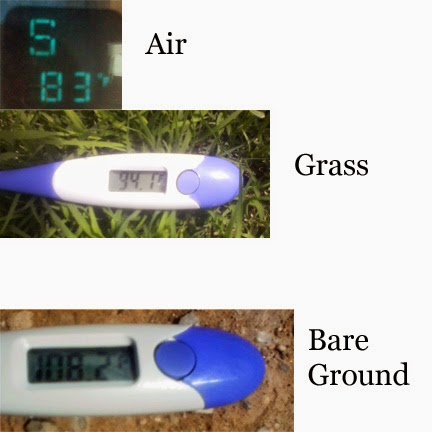
  Notice that the grass covered area is approximately eleven degrees warmer than the air while the bare ground is twenty five degrees warmer than air temperature.

We now have millions upon millions of acres just in North America which have gone from lush grasslands to bare ground and brush in the last 130 years. Add to this the millions of acres of grasslands which have been replaced with buildings and pavement, what is really the cause of global warming? Greenhouse gases (which could be converted to oxygen by grasses) or the depletion of the world's grasslands?


Now lets examine rising oceans. According to scientists, the oceans are rising as a result of the polar ice caps melting. The reason the ice caps are melting, say scientists, is because of rising temperatures. Is this actually the case, or are the ice caps melting due to the ocean levels rising? Once again, the sources of the problem are ignored.                                                                


 The above picture was taken after a thunderstorm dropped under a half inch of rain. As one can see, rather than go into the ground, much of the water is running off.  When a thunderstorm drops two inches and half of it is running off rather than going into the ground, that equals 27,154 water per acre returning to rivers and into the ocean. For every thousand acres this amounts to 27,154,000 gallons of water returning to the ocean, or trillions of gallons of water world wide returning to the sea rather than soaking into the ground.

Adding to the contribution of waters returning to the sea rather than soaking into the ground, is flood control. Water which would flood deltas and return some of it into the ground, are now kept between dykes and returned to the ocean.  How many hundreds of trillions of gallons of water which should be returned to the ground  are now channeled directly into the ocean by the Mississippi River flood control system?
It becomes fairly obvious that the real culprit of rising oceans and temperatures is not greenhouse gases, but depletion of grasslands preventing precipitation from cycling into the ground to replenish ground water, and not insulating the ground. 


Scientists blame depletion of grasslands on "overgrazing."  Keep in mind that this same land which now supports under 90,000,000 cows once supported nearly 300,000,000 bison in addition to millions each of antelope, elk and deer.  The problem is not too many animals on not enough land, but in how those animals are grazed.

Ranchers who have abandoned traditional grazing methods and changed to holistic grazing have actually reversed desertification and restored grasslands. By changing his grazing methods, the rancher below was able to restore the grass on land which was nearly bare to what you see in the picture below. This land has little to no run off because the grasses slow the water and allow it to penetrate the ground.
Mainstream scientists need to get a clue, not only to the real causes of climate change and rising oceans, but in the science behind restoring grasslands to their original state.

Wednesday, February 27, 2013

The Bigger is More Profitable Myth

There is a commonly held opinion within the cattle industry that ranchers need to raise bigger calves to be profitable. Is this opinion fact, or is it a myth?

When I checked the market prices at Amarillo, Texas tonight, 700 pound steers were bringing $145 cwt while 500 pound steers were bringing $187 cwt. This meant (that at least on this day) a 500 pound steer was actually worth $65 more than a 700 pound steer. In reality, that 700 pound steer is costing you more than the $65 difference in market price per head.
The average amount of feed to maintain a cow (depending on whether or not she is lactating, and what trimester of pregnancy she is in) will ranch from 2.5% to 3.5% of her body weight. For the purpose of keeping the numbers round, I am going to use an even 3%.

A 1,250 pound cow will have a daily feed requirement (1250 X 0.03) of 37.5 pounds of feed. This comes out to 13350 pounds of feed per year to raise that 700 pound calf.

A 700 pound cow will have a daily feed requirement (700 X 0.03) of 21 pounds a day, which comes out to 7665 pounds of feed per year.

By dividing the difference in the amount of feed needed to maintain the 1,250 cow by the amount needed to maintain the 700 pound cow, we find that you can actually run 1.78 of the 700 pound cows on the same amount of forage as it takes to run one 1,250 pound cow. This equates to running 178 cows raising 500 pound calves on the same amount of forage as it takes to run 100 of those soggy 700 pound calves. So just how much more money can your ranch bring in with the more moderately framed cows?

Based on the above market prices, you will make $6,500 more per 100 calves on those 500 pound calves. However when you add the additional 78 calves you would raise, this adds another $72,930 which brings the total to $79,430. When you take into account the extra vaccines and wormers you will need, the total will drop a little, but you would still be putting more than $70,000 a year into your bank account on the same amount of feed and forage.

For information on my services, visit NaturalCattle Handling.com If you would enjoy a laugh or two, take a look at my cowboy humor and cookbooks at the 2lazy4U Livestock & Literary Co.

Wednesday, May 2, 2012

Getting Feedlot Cowboys On The Low Stress Bandwagon


There is no doubt that the industry leaders are interested in having low stress cattle handling method being the industry norm rather than the exception. I am no sycophantic elocutionist, all I can do is call things like I see them. Unless there is a direct benefit to the average pen rider , cowboy or ranch hand, they are not going to see the benefit in changing how they work cattle. In order to get the rank and file pen riders and ranch hands wanting to excel in low stress cattle handling we need to do two things. First we need to show that low stress cattle handling is more efficient. Second we need to give them a reason to learn and practice it.
The best way to do this is through a series of competitions in realistic low stress cattle handling to be sponsored by BQA, with a sizable reward (as in cash and prizes) for the winners. This contest would entail riding pens just as if they were riding pens at work, only would be pulling cattle marked with paint balls. A model for the competition wold be;
  1. Twenty pens to be ridden by each contestant with fifty marked animals to be pulled.
  2. Each contestant starts with two hundred points.
  3. A point would be subtracted for each animal that breaks out of a walk.
  4. Two points would be subtracted for causing animals other than the one being pulled to move faster than a walk.
  5. Each contestant would have one marked animal wearing a heart monitor. The contestant raising the hear rate of this animal the least would have ten points added to their score and the second lowest raise of heart rate would receive five points added to their score.
  6. If a rider does not pull all of his marked cattle, they will have two points deducted from their score.
  7. Rider will also have two points deducted for every unmarked animal pulled.
  8. In case of a tie score, the fastest time wins.

While this would not be a spectator sport, it would give pen riders a reason to get interested in low stress cattle handling. If you were to check the death loss and medical costs in any feedlot, you will find that those numbers correlate directly to how cattle are being handled. The less stress being put on cattle, the lower the death loss and antibiotic costs will be. The more stress put on the cattle the higher those numbers will be. The last feedlot I worked at, I asked the hospital crew to run the numbers on all of the pen riders for a year so I could compare them. Between the person who cause the less stress, and the person who caused the least amount of stress, the cost difference was over $250,000. With that kind of losses going on, it seems as if a little prize money as incentive would be a cheap way to get more cowboys on the low stress band wagon.

To learn about my own intensive program for teaching low stress cattle handling in feedlots, visit my website.

Sunday, January 1, 2012

Exports Hurting US Economy


Cattle publications (and too often formal educators) try to convince us that the cattle and beef industries are one and the same. They are not. One difference is in the import export market. While some registered cattle producers may market a few animals to foreign markets, it is not something which the average producer does. On the other hand, every producer of boxed beef is after the premium they can receive from exports to other countries.
While exports can be a good thing for the economy, what is often forgotten is that the economy begins at home. There is a point at which exports benefit a few while making the economy bad for the rest of the economy. This is currently demonstrated by hay exports.
Much of the country has been ravaged by both drought and wildfire. Hay prices are through the roof. Many are paying $300 a ton per hay with it being forecast in some areas to top the $400 mark by the first of February. On the surface this would seem to be a simple matter of supply and demand. Between the drought and fires the demand for hay is higher which would automatically drive up the cost of hay. However there is another factor affecting our hay supply which is driving the cost up. A record amount of hay is being exported to China, partially because it is actually cheaper to ship it to China than to points within the United States.
While economists view this as a good thing for the trade imbalance, it is detrimental to our overall economy. This is driving up the cost of both beef and dairy products for consumers who are suffering enough in this down economy. While it would seem logical that trade agreements and export laws would take our own economy into consideration before allowing either exports or imports. Unfortunately economists too often consider the balance sheets between our country and others without looking at the effects upon our own general population.
That is the difference between the cattle and beef industries. The beef industry can benefit by premiums, either in actual price, or lower shipping costs. The relationship between the cattle industry and beef industry is similar to that between mining companies which supply iron ore and steel manufacturers. As cattle producers we are providing the “beef ore” for packing companies to turn into beef.
We can not depend on them for our individual economic situation to be better, nor can we expect the government to protect our interests. As such, our only formula for success is to keep our outputs low enough that our inputs cover the costs with enough left over for a livable profit. We need to manage our forage so that we are planning ahead for the times of drought an/or low prices. We cannot avoid all outputs, but we need to manage them so that what outputs we do have benefit our output to input ratios. This includes everything from handling our cattle in a way which reduces shrink, to making our infrastructure less costly to maintain to how we manage our household purchases.
This last has been made a bit more simple by the internet. We can now purchase everything from vaccines and tools, to clothing, and even some foods and have it delivered without the expense of driving a couple of hundred miles to town. One such opportunity is provided by Country Outfitters. A few weeks back I was approached by them to do a product review in exchange for whatever I wanted to order. I browsed through their products and was surprised at their variety and prices. As it is winter, I chose the Carthart® arctic lined coat. It had the quality you know is going to be there, including a long lasting brass zipper rather than the cheap plastic ones used by other manufacturers. The prices are comparable to what you find at stores in town, yet you don't have to make the trip. With calving season upon us Country Outfitters an be your own on ranch store if you find yourself in need of extra winter wear or a new hat to wear to the stock show.

Tuesday, December 20, 2011

Low Stress Cattle Handling/Horsemanship Clinics


You cannot substitute articles and videos on reduced stress cattle handling procedures for real time, hands on experience to become proficient at handling cattle. Few of these articles and videos address the differences involved between handling cattle on foot or on a horse. Fewer still describe how, by simply changing the angle of your horse's body in respect to the cow, you can control the cow's speed and direction.

For a person handling cattle horseback on a ranch, or riding pens in a feedlot, you cannot learn how to handle cattle in a reduced stress manner without including horsemanship. Low stress cattle handling is synonymous with good horsemanship, you can't have one without the other. While those teaching low stress cattle handling on foot concentrate on reading cattle and making small corrections to keep things going, many of those teaching it from horseback are still doing many of the same old things. Keeping a horse parallel to a cow, beating it to the fence and working, prey/predator relationship, and training cattle to drive.

The word natural is over used and often misconstrued. The way your cattle act right now is only their natural reaction to what you are doing. The key to low stress cattle handling is to do things in a manner which naturally gets cattle to doing what we want in a calm manner.

If we are driving a cow and keeping our horse parallel to the cow and decide we need to turn it, we start putting pressure on their eye to get them to turn away from us. When we do this we turn our horse towards the cow and they speed up and try go around us. We blame the cow for speeding up and trying to go around us, but we are the one who turned on that switch in the cow to get that reaction.

In the same situation if we are tracking the cow with a slight amount of lateral movement on our horse we can actually ask the cow to turn by taking pressure off the cow. We do this by asking our horse to speed up slightly while moving laterally away from the cow. When we do this, we are taking away both the instinct of the cow to speed up and to go around us. Instead the cow feels as if its opportunity to go around us is taken away. At this point, rather than being excited and wanting to get around us, the cow's reaction is to turn slowly (without stress) away from us and in the direction we want.

In order to take advantage of the above natural instinct of cattle, we need to develop our horsemanship to a higher level. At times we can slow a cow by simply changing the angle of our horse in relationship to a cow. Essentially, the better our horsemanship is, the more we can master low stress cattle handling. This isn't to say our horses have to be perfect, as there is no true perfection. However if we master our horsemanship enough we can take advantage of methods to handle cattle with lower amounts of stress, not only on the cattle, but on our horses and ultimately on ourselves. The easier you make things on the cow, the easier it is on your horse, and the easier it is on you.

The answer to the conundrum of how to learn both the horsemanship techniques and the lower stress reactions of cattle is to learn them both at the same time. After years of thought on the matter I have designed a clinic program which addresses both the horsemanship and low stress instincts of cattle. As learning all of this is intensive, hands on clinic sizes will be limited to a total of seven participants, including crew or owners of sponsoring ranches. To learn more of my methods and all these clinics cover visit my main website.

I am now accepting host ranches for 2012 clinics. If you are going to be running yearlings, coinciding a clinic when you receive cattle, they will be calm and easy to handle when you turn them out with no additional labor costs. If you are running an AI breeding program I can also include training on how and when to pen your cattle for minimum stress and optimum conception. If you would like to host a clinic, email me me and we will make arrangements.

Tuesday, September 13, 2011

Are Current Pasture Conditions The Fault of Drought or MAnagement?

There is one thing I have noticed on nearly every ranch I have visited this year that disturbs me. Nearly every ranch has large areas of unused grass that cattle won't eat because it is gray, matted and rank. Some ranches have literally thousands of acres of this (currently) useless grass. The cause of this is not the drought, but conventional low density continuous grazing methods.

The biggest problem with low density grazing is that cattle are creatures of habit, as are many of their owners. Once cattle are located in an area they tend to keep going back to the same location. This results (especially on larger ranches) in cattle grazing one area to the ground while ignoring other areas which become entirely inedible for both livestock and wildlife. Either scenario results in little available forage for livestock or wildlife during times of drought. Why do the gray matted areas of grass exist?

They exist is because cattle have been comfortable in past years where they were at without grazing these areas. Without enough animal impact these areas have gone through their growth cycle several times to the point that two things happen. First, not enough sunlight is getting to the new grass to create the photosynthesis needed for growth. Secondly, when rains are measured in trace amounts of moisture rather than inches, not enough moisture reaches the ground to make grass grow. Is it possible to repair these areas enough to induce growth with minimal amounts of rain?

Actually it is simple. Many (if not most) ranches are feeding cake. Being the creatures of habit we are, we continue to feed the same cattle in the same area every time we feed. By feeding cake or hay on these dry matted areas we will be using herd effect to both trample the matted grass into the ground (allowing more sunlight for photosynthesis) while also tilling the ground with the hooves of the cattle, which allows rain to soak deeper into the ground.

For some reason, there are many people who do not believe that herd effect allows for more efficient plant use during times of minimal moisture. There is an easy experiment you can do to discover what herd impact has without using a single cow.

You can use either bare hard ground, or a patch of ground where you have gray matted grass. Measure out a 10 X 20 foot plot, then cut them in half. To simulate a short term, high density herd impact, rake one of the 10 X 10 about ½ and place a rain gauge at the halfway point of the dividing line. Place a sprinkler so that both plots receive the same amount of moisture, until the rain gauge has about ¼ inch. Then compare the amount of penetration of the water.

To see results from doing this, visit Dan Dagget on You-Tube for the kind of results you can achieve. As usual, your comments and suggestions are welcome!

Wednesday, March 16, 2011

Adjusting Today's Prices

Nearly everyone is happy about record high cattle prices. A lot of investors are looking at cattle as a "good investment" right now. However when you really look at input costs, you are receiving less for calves today than you were in the late 1970's

In 1979, I worked for a rancher who sold his calves for $125cwt. At the time, a new four wheel drive pickup was about $10,000 and a "high paid" cowboy made $500 a month and beef. Day work was expensive at $50 a day. Hay was roughly $45 a ton and gas was well under $2 per gallon.

Today's calves are bringing roughly $58 per cwt more, less than a 50% increase. Many cowboys are now starting out at $1,500 a month, or three times higher. Day labor has doubled at $100 a day. That four wheel drive pickup now costs $40,000, or four times as much. Hay costs over a $100 a ton (more than double) and gas is getting close to $4 a gallon and in many places, diesel is already over $4 a gallon (again, doubled). This does not take into account not only higher land prices, but higher property taxes as well. This means, after figuring input costs, your cattle are actually worth less than they were in 1979. If cattle were even keeping up with labor costs, today's calves should be bringing $3.75 cwt.

I can think of a number of things that 90% of cattle operations today could do to lower input costs. Most of these ranches could do to increase stocking capacity and the total pounds of cattle shipped from their ranch while lowering input costs. What are you doing to increase the efficiency of your cattle operation without increasing your input costs?

Saturday, March 5, 2011

Can You Afford To Burn Money?

I know of very few people who can afford to burn hundred dollar bills ten at a time, but many ranches tend to do just that every time they work cattle. This seems to be especially true on desert ranches where time is spent, not in the cattle, but constantly checking waterlines.

This past week I day worked on a local ranch which I've worked on before. Cattle are scattered out in groups of a hundred to two hundred per pasture, with the average pasture size around two thousand acres. If the cattle were ridden through even once a week, and handled with reduced stress methods one person could gather the cattle into the pens with no help, and a crew of four or five could get done with the sorting, branding, vaccinating and castrating fairly easily.

As these cattle only see people horseback when they are going to the pens to get worked, they are not only trotty, they have no intention of going into the pens. Since it is a known "fact" that the cattle are going to be hard to handle the crew grows to nine people, or an extra four or five hundred dollars a day.

Finding cowboys to work for day wages is hard. Finding cowboys that work for day wages who also work cattle in a reduced stress manner is next to impossible. As a result, when the cattle start getting leery of the pens, rather than back off and keep them quiet, the charge is on to get them into the pens as fast as possible. The pressured cattle wind up running off and in the ensuing stampede, calves have more stress related shrink, which winds up in higher than necessary morbidity and mortality rates. It also results in having to go back out to the pasture and roping calves that got away. At today's cattle prices this is costing in the neighborhood of thirty dollars per calf, or burning thirty one hundred dollar bills for every hundred calves you wean.

This week the ranch I worked on, between having to hire extra help, and their methods basically burned two hundred and five, one hundred dollar bills. If this isn't burning enough money, the cattle we worked this week is only one third of their herd, so between weaning the three groups, they are burning six hundred and fifteen of those one hundred dollar bills a year on weaning alone. Add a third that much shrink loss during branding and you are looking at over eighty thousand dollars a year going up in smoke.
Even including all related expenses, paying a cowboy thirty thousand dollars a year would save this ranch a minimum of forty thousand dollars a year. However the mentality seems to be that if a person is horseback in the cattle they are not "getting anything accomplished."

If you are tired of burning hundred dollar bills, and would like to learn more about reduced stress cattle handling, click here.

Tuesday, January 11, 2011

Taking Cattle Through Gates

Last week I covered starting and moving your cattle in a way which instills herd instinct in your cattle. Taking cattle through gates can either be one of the easiest things we can do with our cattle or one of the most stressful things we can do to our cattle, and ourselves.

Too many people tend to wait to open the gate until all of the cattle have reached the gate. This results in the cattle being forcibly crowded up to the fence. This creates stress on the cattle as they do not like to be forced together. When we are moving pairs this assures that the cattle will not be paired once they are through the gate. If we can have the gate open before the cattle get there, it is a simple matter of pointing them towards the gate without stopping the motion.

If the motion does stop, the only two things we need to work on is keeping the everything pointing towards the gate, and getting the cattle at the front to go through without pushing from the back. When you do this properly all of the cattle will go together, strung out as a herd naturally moves. Once they start through, the lead may pick up speed and may even run and play a bit. As long as they are headed in the right direction there is nothing to worry about as they tend to slow down on their own.

The two hundred steers in the following video had only been on the place a week. The only other time I had moved them was taking them from the pens where they had been unloaded, to this pasture. Not only was this the first time they had been through this gate, the pup I was using is deaf, and I didn't have a shock collar. Needless to say she made a few mistakes (to put it mildly) but the steers still all made it through the gate, and acted as a herd once they went through.


Taking cattle through a gate in the middle of a fence is actually easier than taking them through a gate in a corner. Take the cattle to a point a hundred yards to either side of the gate and have them turn down the fence towards the gate. Ride along, or just in front of the lead animals. When you reach the gate, simply get in front of the lead animals and position yourself so that the lead will go around and by you. They will see the gate and go through easily.

Sunday, January 2, 2011

Starting and Turning Your Cattle as a Herd

In my last post I described how to begin training cattle to act as a herd. When cattle begin acting as a herd, they will all be facing in the same direction when grazing, as in the picture. It doesn't matter if you have a herd of thirty, three hundred or over a thousand, the cattle will be facing the same direction like in this photo.


Their natural instinct at this point is for everyone to follow the lead animals. By simply taking advantage of their instinct to go by you, the cattle will automatically start up as you make your approach from the front. If you try starting them from the back you will not get them to go in the same direction. Starting the herd from the back is asking the cattle on the lower end of the pecking order to pass up the cattle which are higher on the order. Rather than pass them up directly they will tend to go around them, resulting in the cattle starting out in three different directions.

One thing you need to remember. Cattle are comfortable and relaxed in a tight situation if they feel it was their idea to do so. When you force them into the situation, it causes stress similar to being pursued by predators. Therefore it is in your best interest to handle them so that they want to act as a herd. Anything you do to work against their herd instinct will only make you work harder to move your cattle, let alone getting them to behave as a herd.

Another area of concern is turning your herd. When following a fence line, there is a tendency to ride between the cattle and the fence, from the back to turn them. This results in the back end turning before the front end and the cattle spreading out. When turning a herd in open country the tendency is often to ride at the shoulders of the lead cattle to force them to turn. Once again, the key word her is force. Anytime you are forcing the cattle to do something, you are creating stress in the cattle which creates more work for you and your horse.

When your cattle are acting as a herd (or if you are wanting them to start doing so) you need to take advantage of every situation to let them do what you want, rather than forcing them to do so. When the cattle are going down a fence, simply ride past the cattle from far enough out that you do not slow them down or stop them. When you are in front of the cattle turn and ride at an angle towards the lead cattle. As you are riding toward them, the lead cattle will actually speed up to go around you and turn in the direction you want. You may have to make an adjustment in how much they are turning, but with a little practice, they will be turning nearly exactly the angle you are wanting them to turn. Herd instinct will take over and the rest of the herd will follow on their own.

This same method will also work when changing direction in open country. Rather than forcing the cattle to turn set them up to go around you. For instance, if you want to turn the cattle to the left, ride ahead of the cattle on the left side of them. When you want them to turn, simply ride towards them at an angle. This will allow the cattle to follow their instinct to speed up and go around you. Once the lead has made their turn, you can simply stop and let the rest of the cattle to follow them.

You have probably noticed I use the terms “allow” and “let” quite a bit when describing how to move cattle. This is because when you are handling cattle correctly, you are only setting yourself up to take advantage of the natural instincts of cattle. Simply put, when you approach cattle in any manner their reactions are what their instincts are telling them to do. If you try forcing things you are working against their instinct to act calmly as a her. By keeping your patience and making the right approaches, you are allowing them to make their own decision to go where you want as a herd.

Next week we will discuss taking cattle through gates in a way which instills herd effect. If you have any questions be sure to post them in the comments and I will answer them!

Friday, December 24, 2010

Evaluating Our Management

It is that time of year again. No, I'm not talking about Christmas. It is the time of year that all of the trade publications are encouraging you to re-evaluate your management and pay your dues to the cattleman's associations. I think it is not only time to re-evaluate your cow herd management, but to also evaluate how these publications are suggesting we manage our cattle.

The sustainability of any cattle operation is dependent upon profitability. Nearly anything we do to increase income seems to involve putting money out to accomplish. As an industry, we have acquired a mindset which dictates we must spend money to save money. This is a mindset which we need to get away from. There are too much of what we are doing as an industry which are adding to operating expenses which we take for granted as being necessary could be changed.

The educational system doesn't help. Rather than giving advice as to reducing costs associated with calving January to March, they give advice on how much feed and nutrients cattle need during the third trimester during the holiday season (as in a recent article from the University of Ohio). A study just started this fall at of Nebraska College of Technical Agriculture is examining the difference between calving in September/October vs January/February.

If you have a ranch, or are managing one for someone else, you need to be thinking of two things, sustainability and profitability of the range land and cattle. If you are calving at a time of year that requires you to feed extra hay and supplement to your cattle during the extra trimester, you are cutting into the profitability of your cattle. If you are feeding your calves as well as feeding enough for your cattle to lactate and hold body condition, you are cutting into your profitability. You should be asking yourself why there are no studies being done on timing the third trimester so that cattle are calving on green grass rather than purchased feed and supplement.


Simple logic dictates that calving on grass is less expensive than paying for hay production and extra supplements. Just how much can you save? I have one friend who calved in June/July in western Colorado who didn't feed his cattle at all. I have another friend in Nebraska who changed to a late April/early June calving season and he now feeds 2/3 less hay. Both men weaned at an correspondingly later time, with nearly identical weights to winter calving. How much money would you be adding to your profit line if you could cut your hay bill by 2/3? Could you make even more money by selling the excess hay you have been feeding, or increase the size of your herd with the savings?

Another area in which advice given by universities and publications is pasture management. There are many articles out there which give the benefits of rotational grazing programs, but all of them require intensive labor and monetary investment in permanent and temporary fencing to control grazing. Can we really be more sustainable, or get more profit when we are spending more time and money to accomplish the same task of harvesting grass?

Then we have all of the articles on reduced stress cattle handling. There are two kinds of articles in this category. The first kind are the ones which appear as if they were written from a template. They contain all of the buzz phrases “slower is faster,” “flight zone,” “pressure and release,” then go on to explain the benefits. Yet they fail to really describe how to handle your cattle with less stress.

The other category is people who have no real understanding of how cattle work other than to train them by the Pavlov's Dog method. This method prescribes training your cattle to lead, which of course is accomplished by using feed. This may sound like a good method but it is much like gentling a horse by feeding it, without asking it to do anything. When you get them in the pens and start sorting or working them, like the horse, they may have no fear of you, but they don't have any respect either. The end result is still more stress on the cattle than needed.

Cattle are herd animals. Yet we have been trained over the years to think it is normal for our cattle to spread out across the pasture when we let them through the gate. We have been “educated” to believe we need fences to keep them where we want, and several people to move them. We have been educated on this so much that most people don't recognize actual herd behavior when they see it. In fact this lack of recognizing what a herd looks like is so bad, that I have had people inform me there was something wrong with cattle when I had them working as a herd. Next week I will begin describing not only how cattle act as a herd, but also how to re-establish herd behavior in your cattle.

The final thing I want to touch on this week is the current high market in live cattle. Your banker will be encouraging you to go into more debt for cattle because they are worth so much. Of course this is standard protocol when the market is going up. The problem is that the cattle market is cyclical, which is exacerbated by the global market and whatever flavor of the month USDA comes up with for meat imports. Prices were at or below breakeven for many producers until Canada had a case of mad cow disease. As soon as the access to Canadian cattle was closed, US prices went back up. Despite the current bear market on cattle, I would recommend you resist the temptation to acquire debt to build your herd. In fact, this may be the best time to liquidate your herd to someone who is following their banker's advice. Then you can lease your pastures to yearlings and sell your hay, or lease to pairs where you are guaranteed profitability. By carefully managing your finances, you will be solvent enough to rebuild your herd when the market drops again. When the others are going bankrupt, or getting out of the business because cattle aren't worth anything, you will be able to shift your income from leasing to selling cattle.

Until next week, have a Merry Christmas and think out of the box!