Showing posts with label #holisticmanagementInternational. Show all posts
Showing posts with label #holisticmanagementInternational. Show all posts
Friday, January 27, 2017
Stockmanship 101 Now Availible on Amazon!
Thanks to those who supported the project, the English version of Stockmanship 101 (rebooting herd instinct) is now available on Amazon. This video was premiered at last week's school at Rancho Terrenates in Chihuahua, Mexico, where some students actually watched it a second time. It was also well received at a short seminar in Chihuahua City, Mexico where several students from my first school at Rancho De Las Damas were in attendance. Humbling to know that such a high percentage of those you teach are able to carry on the concepts when they get home!


Tuesday, July 28, 2015
Month Long Holistic "Herd Building" Stockmanship Schools
The recently formed partnership between Rodger Savory of Savory Grasslands Management and Jervoise Station, is not only changing the grazing management from conventional to holistic, but also transforming the station into a holistic grazing learning center.
The 70,000 acre Jervoise Station is the first Savory Institute satellite Hub in Australia. For their first educational opportunity, they have invited Bob Kinford to put on three, one month "Herd Building" stockmanship schools. These schools will be similar to the one sponsored last fall by Queensland Dry Tropics. However the length of these schools will give students a better understanding of not only building herd instinct, but in actually taking the cattle through a grazing plan without the use of cross fencing.
In the past, schools were only a week long. While that is long enough to bring herds of 1,000 cows into "herd mode" it was hard for students to break their old habits of conventional stockmanship. These longer schools will give students a chance to break their old habits and establish themselves in a group of elite cattlemen, with a unique set of skills. This will qualify them for employment not only on stations practicing Holistic management in North Queensland, but anywhere in the world this style of grazing is practiced.
For more information on enrolling in these schools, email Jervoise Station.
Bob Kinford's website.
The 70,000 acre Jervoise Station is the first Savory Institute satellite Hub in Australia. For their first educational opportunity, they have invited Bob Kinford to put on three, one month "Herd Building" stockmanship schools. These schools will be similar to the one sponsored last fall by Queensland Dry Tropics. However the length of these schools will give students a better understanding of not only building herd instinct, but in actually taking the cattle through a grazing plan without the use of cross fencing.
In the past, schools were only a week long. While that is long enough to bring herds of 1,000 cows into "herd mode" it was hard for students to break their old habits of conventional stockmanship. These longer schools will give students a chance to break their old habits and establish themselves in a group of elite cattlemen, with a unique set of skills. This will qualify them for employment not only on stations practicing Holistic management in North Queensland, but anywhere in the world this style of grazing is practiced.
For more information on enrolling in these schools, email Jervoise Station.
Bob Kinford's website.
Sunday, August 31, 2014
Underestimation of lost rainwater
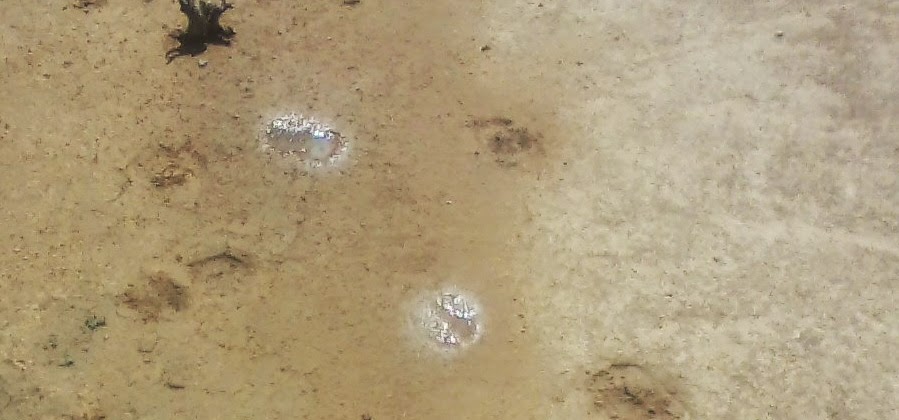
If you read my post on Why Climate Change scientists are clueless and were amazed at the amount of water which runs off after a rain, I underestimated it. Actually I grossly underestimated it as the following picture illustrates.
 How much more water would have gone into this ground if cattle were being run as a herd instead of being scattered out? The picture below would have had hundreds of tracks to fill with water instead of just two, which would have captured the water instead of letting it run away.
Friday, August 8, 2014
Why Climate Change Scientists Are Clueless
Like Chicken Little yelling "The sky is falling" climate change scientists are giving reasons behind the phenomenon which are largely unrelated to the actual causes. One of the false flags behind "global warming" is greenhouse gases. They may contribute a small amount, but in reality it is the lack of grasslands which it the biggest contributor.
Early day explorers described the vast majority of western America as a "sea of grass." While there are no stories describing how settlers livestock died of starvation, there are plenty of livestock perishing from a lack of water. Today much of this land has become bare ground because of the lack of proper animal impact. To demonstrate just how much the lack of grass cover reflects heat back into the atmosphere, I checked the air temperature, then checked the temperature on a patch of grass, and also a path of bare ground.
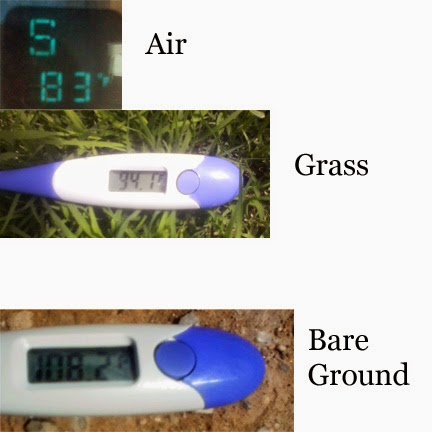 Notice that the grass covered area is approximately eleven degrees warmer than the air while the bare ground is twenty five degrees warmer than air temperature.
We now have millions upon millions of acres just in North America which have gone from lush grasslands to bare ground and brush in the last 130 years. Add to this the millions of acres of grasslands which have been replaced with buildings and pavement, what is really the cause of global warming? Greenhouse gases (which could be converted to oxygen by grasses) or the depletion of the world's grasslands?
Now lets examine rising oceans. According to scientists, the oceans are rising as a result of the polar ice caps melting. The reason the ice caps are melting, say scientists, is because of rising temperatures. Is this actually the case, or are the ice caps melting due to the ocean levels rising? Once again, the sources of the problem are ignored.

The above picture was taken after a thunderstorm dropped under a half inch of rain. As one can see, rather than go into the ground, much of the water is running off. When a thunderstorm drops two inches and half of it is running off rather than going into the ground, that equals 27,154 water per acre returning to rivers and into the ocean. For every thousand acres this amounts to 27,154,000 gallons of water returning to the ocean, or trillions of gallons of water world wide returning to the sea rather than soaking into the ground.
Adding to the contribution of waters returning to the sea rather than soaking into the ground, is flood control. Water which would flood deltas and return some of it into the ground, are now kept between dykes and returned to the ocean. How many hundreds of trillions of gallons of water which should be returned to the ground are now channeled directly into the ocean by the Mississippi River flood control system?
It becomes fairly obvious that the real culprit of rising oceans and temperatures is not greenhouse gases, but depletion of grasslands preventing precipitation from cycling into the ground to replenish ground water, and not insulating the ground.
Scientists blame depletion of grasslands on "overgrazing." Keep in mind that this same land which now supports under 90,000,000 cows once supported nearly 300,000,000 bison in addition to millions each of antelope, elk and deer. The problem is not too many animals on not enough land, but in how those animals are grazed.
Ranchers who have abandoned traditional grazing methods and changed to holistic grazing have actually reversed desertification and restored grasslands. By changing his grazing methods, the rancher below was able to restore the grass on land which was nearly bare to what you see in the picture below. This land has little to no run off because the grasses slow the water and allow it to penetrate the ground.
 Mainstream scientists need to get a clue, not only to the real causes of climate change and rising oceans, but in the science behind restoring grasslands to their original state.
Early day explorers described the vast majority of western America as a "sea of grass." While there are no stories describing how settlers livestock died of starvation, there are plenty of livestock perishing from a lack of water. Today much of this land has become bare ground because of the lack of proper animal impact. To demonstrate just how much the lack of grass cover reflects heat back into the atmosphere, I checked the air temperature, then checked the temperature on a patch of grass, and also a path of bare ground.
We now have millions upon millions of acres just in North America which have gone from lush grasslands to bare ground and brush in the last 130 years. Add to this the millions of acres of grasslands which have been replaced with buildings and pavement, what is really the cause of global warming? Greenhouse gases (which could be converted to oxygen by grasses) or the depletion of the world's grasslands?
Now lets examine rising oceans. According to scientists, the oceans are rising as a result of the polar ice caps melting. The reason the ice caps are melting, say scientists, is because of rising temperatures. Is this actually the case, or are the ice caps melting due to the ocean levels rising? Once again, the sources of the problem are ignored.
Adding to the contribution of waters returning to the sea rather than soaking into the ground, is flood control. Water which would flood deltas and return some of it into the ground, are now kept between dykes and returned to the ocean. How many hundreds of trillions of gallons of water which should be returned to the ground are now channeled directly into the ocean by the Mississippi River flood control system?
It becomes fairly obvious that the real culprit of rising oceans and temperatures is not greenhouse gases, but depletion of grasslands preventing precipitation from cycling into the ground to replenish ground water, and not insulating the ground.
Scientists blame depletion of grasslands on "overgrazing." Keep in mind that this same land which now supports under 90,000,000 cows once supported nearly 300,000,000 bison in addition to millions each of antelope, elk and deer. The problem is not too many animals on not enough land, but in how those animals are grazed.
Ranchers who have abandoned traditional grazing methods and changed to holistic grazing have actually reversed desertification and restored grasslands. By changing his grazing methods, the rancher below was able to restore the grass on land which was nearly bare to what you see in the picture below. This land has little to no run off because the grasses slow the water and allow it to penetrate the ground.
Subscribe to:
Posts (Atom)