Showing posts with label hydrology. Show all posts

Tuesday, January 1, 2013

The Value of Holistic Herding

Many people look at what I am doing with holistic herding don't see the value. The first misconception that most people have is that, on their ranch, it would be impossible to do. The owners of the cattle I am currently herding once thought that as well. I first presented the idea of combining their cattle into one herd five and keep them moving years ago. Their reaction was "It is impossible to do" in this area. Now that they have been forced by drought (less than 10 inches total over three years) to lease pasture and have their cattle herded on the Circle Ranch  they are totally sold on the idea.

The benefits of holistic herding are:
  1. You know where your cattle are 
  2. You know what the condition of your cattle are
  3. You can gather your cattle in one day, without hiring day help
  4. Cattle actually do better in a herd situations than in small groups
  5. Take advantage of grazing areas cattle don't normally graze
  6. Concentrating the cattle and moving them concentrates manure and herd effect, which in turn helps build soil and increases both the amount and diversity of forage while improving hydrology of the land
  7. By increasing forage and areas you can graze increases your ability to either run more cattle or lease grass for yearlings.
  8. Reduces the amount of infrastructure to maintain in order to keep the cattle watered
  9. Reduces overall fuel, maintenance and labor costs.
  10. Reduces the amount of water needed

 Numbers eight and nine are hard for people to wrap their minds their minds around. Using the Circle ranch as an example, this is easy to explain. There are an average of five water points per pasture. In a herding situation, it is possible (and preferable) to water the herd at a single water point. By placing a single water point with covered storage in each pasture the Circle ranch would reduce the amount of driving to check water by as much as 80% (The costs implementing this could be offset by selling your now defunct drinkers)

How can it reduce the amount of water you need? A five foot diameter drinker has an annual evaporation rate of 750 gallons per drinker meaning that each of the pastures would require 3,000 less water per year or 51,000 gallons less water for the whole year (not counting the 1,000,000 lost in evaporation in the existing uncovered storage tanks ). How much would this reduce your ranch's electric and fuel bills in a year?

Once a person get past the excuse of not being able to herd holistically, there is no reason not to do it.

If you appreciate the free information you get from this blog, you will also enjoy the books and e-books I have on available on Amazon from my company website!


Friday, December 16, 2011

Are You Managing Wildlife, Livestock, Or Forage ?

Look at nearly any help wanted ad looking for ranch management and it is fairly obvious that every ranch has it's management priorities. The problem in developing management programs which focus on a certain species of animal is that they are so focused on developing a program for your particular niche that we develop tunnel vision. When we hire a manager with a specific degree to manage for our specific management niche we are often focusing our tunnel vision even more. More often than not we are like a drug addict too stoned to notice we are shooting ourselves in the foot. This is especially true in wildlife managers who have been taught that livestock competing for forage is detrimental to wildlife populations.


The tunnel vision developed by an educational system which focuses on niche management tends to overlook the bigger picture. Environmentalists and wildlife managers want to remove livestock from the land to protect it. However this is often counter productive to forage development and diversity. Many of us have, for one reason or another, come to the conclusion that if we leave the land to nature, that nature will heal the land on it's own. The only problem with this theory is that nature today is not what nature was even a hundred years ago. We  have removed the tool nature used to develop forage and plant diversity. This tool of nature was large herds of free roaming grazers that grazed through an area and were gone for a period of time, letting the land and plants rest. This grazing pattern loosened the top of the soil allowing rain to soak into the ground rather than run off, removed the top two thirds of plants allowing light to reach the base of plants speeding up photosynthesis while fertilizing the ground from feces and urine.

 When we took away the tools nature has provided to take care of itself, we minimized our chances of real improvement or even sustaining what forage we have. The only way we can viably sustain and improve the forage and environment for wildlife is to find a substitution for the tools of nature which are no longer available. 

The substitution for the large herds of grazing animals is controlled rotational grazing of  livestock. The most effective method is by training a herd of stock to act as a herd and place them in a different area to graze on a daily basis. This does not mean having a person with the herd all day, but simply training your stock to act as a herd and place them on a daily, or near daily basis. To find out more of how easy it is to train livestock to act as a herd, and how this kind of grazing system can improve conditions for your game animals and birds, visit the following websites:

By using these methods you will not only be helping improve the ecology of your ranch, but also providing food for the world.


Thursday, July 7, 2011

Improve Forage & Hydrology By Grazing "Impossible" to Graze Locations


 While holistic grazing programs can improve the biodiversity and hydrology of a pasture the source of erosion usually begins on steep side hills. As these areas are often ignored by cattle, and are hard to fence, so they are left out of grazing plans as being "impossible" to graze. The fact is, it is not only possible to graze these areas, they are prime locations to improve both forage and hydrology of pastures.

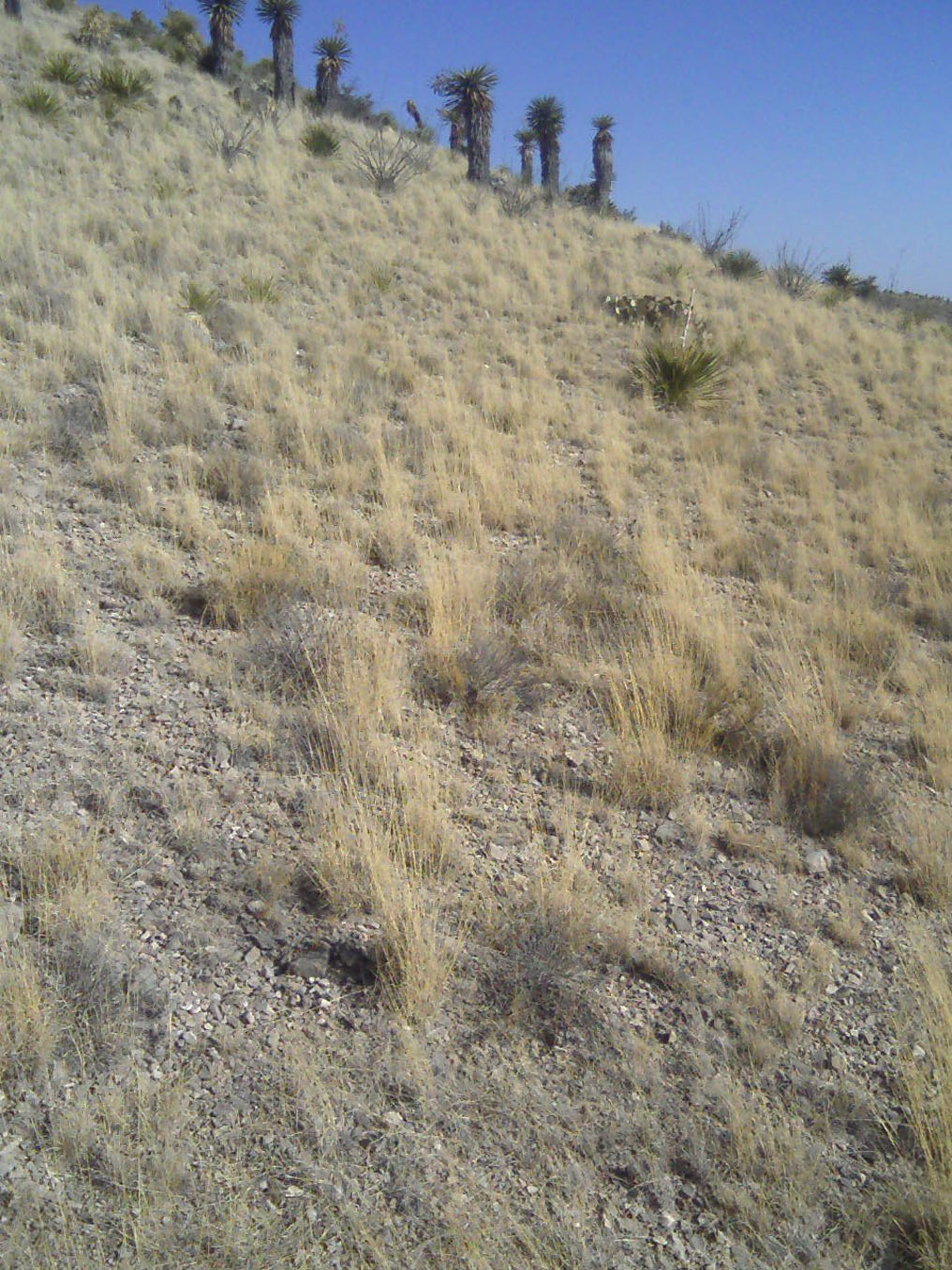
While the cattle were being rotated through the pasture in the picture to the left, they were, for the most part, allowed to graze where they wanted. You can tell where they grazed by following the outline of the healthy yellow grass. As soon as the ground began to get too steep, or too rocky, the cattle would ignore it in their grazing pattern.

Upon closer inspection of these rocky areas, there is grass, but it is gray, matted and very unhealthy.
The picture above shows just how sparse and unhealthy this grass is. When it rains, there is not enough grass to slow water down and erosion begins. Notice in the above picture that some clumps of grass have no individual stalks of grass while others have just a few.  In the picture below, I conducted a short experiment the last time cattle were in this pasture. Taking roughly two hundred cows, I herded them up a side hill to graze on steep, rocky ground with the grass in a condition similar to the picture above.

The results of this are in the picture below. Notice the grass is healthier and had much more growth than in the picture above. This is the result of grazing the cattle through this area one time. By utilizing "impossible to graze" slopes such as this you are improving biodiversity, hydrology, and stocking rates. At the very least, utilizing these areas will allow you to run at full capacity (as prescribed by conventional) methods while giving each grazing area once every two years. Feel free to ask questions or make comments below.