Showing posts with label #SavoryInstitute. Show all posts

Monday, October 14, 2019

Political Partisan of Climate Science...Long Live The Science, The Science is Dead,

There seems to be a tendency today for people to ridicule others for not accepting "settled science," even though science is never "settled." If science was settled, vaccines would have never been invented, nuclear energy (nor solar energy)  would have been developed. There would be no flying machines, computers or cell phones. Yet today we seem to have "settled science" at opposite ends of the spectrum. There seems to be little to no thought given to the point that perhaps both scientific models are wrong (after all, if we can't forecast tomorrow's weather accurately, how can we predict the climate 30 years from now?)  There also seems to be little thought as to why (or even how) science is divided upon political ideologies.

The science of the "left" claims their science is settled and we only have 12 years until the end of the world. Endless studies, graphs and charts prove them to be right. Anyone denying their claims are only deniers of science. Long live the science...the science is dead...long live the science.

The science of the "right"espouses that most of the climate change we are seeing is simply cyclic in nature, that man as little to nothing to do with it. Their graphs, models and studies on historical climate trends show us in a certain point in the cycle. If you don't agree with them, you are denying science and fear mongering to create a one world government.   Long live the science, the science is dead, long live the science.

The arrogance abounds in both sides of this discussion. The "right" is seemingly oblivious to the fact we have subtracted from (as well as added to) so many things to the environment that it is either naive or arrogant to believe we haven't affected the climate. On the left side, the science revolves around greenhouse gases.

You cannot have an accurate model, nor reach a scientific conclusion unless all of the variables affecting the outcome are included in the research, yet this is what both sides of the climate discussion are doing. Those on the right are ignoring all of the things we have been doing for the last 200 years, and those on the left ignoring things which are beyond the parameters of atmospheric gasses.

At 2.9 acres per mile of two lane road, plus airports, military installations and parking lots, we are pushing 100,000,000 acres (in the USA alone) reflecting heat back into the atmosphere in addition to disrupting soil hydrology....ignored by both sides of the "settled science" of climate change. This is ignored by both sides of the discussion.

Also ignored by both sides of the discussion is urban expansion and the flood control projects. Millions of acres heat reflecting buildings replacing carbon sequestering plants of all kinds, along with the flood control projects, not only replacing oxygen producing plants, but assuring that the "excess" water goes into waterways and eventually into the ocean rather than into the soil in the natural water cycle.

While the left side of the argument acknowledges the carbon emitted by air travel they fail to take into account how the heat and turbulence produced at high altitudes may affect weather patterns. (over 30,000 commercial flights a day, and with the larger planes creating so much turbulence single engine aircraft must wait for 7 minutes for the turbulence to die down enough for a safe take off) 

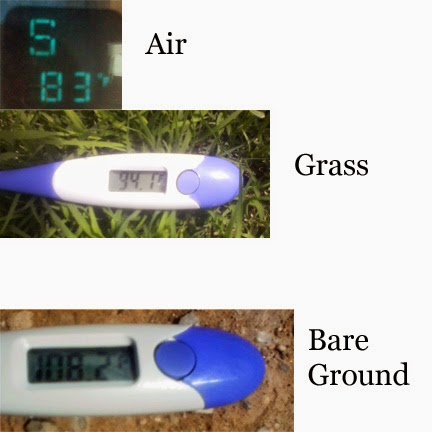
Last on my list (which may not be complete) is degradation of soil, otherwise known as "desertification." Despite the fact roughly two thirds of the world's land being in some stage of desertification, neither side acknowledges this to be a contributing factor to climate change, the left side incredibly considers it to be a "symptom" of climate change.  At 98 F ground temperature in healthy grass is only 78 degrees while on bare ground it is 128 degrees (and even hotter on the fore mentioned roads and parking lots...)  The fact the left doesn't take this into consideration as a cause of climate change is absolutely mind boggling.

I accept the fact we are effecting the global climate.  However, when the "settled science" posited by left fails to take all of the different contributing factors into account, how accurate can they be? When they don't just make claims, but change from global warming to global cooling, then, when their predictions fail, change it to simply "climate change,"  how accurate can their science be?

Some will label anyone who questions the politics behind climate change as a "science denier" or "climate skeptic" when in reality many of us are only questioning the motives behind the politics.

How do you believe in a "climate summit" which looks at a "carbon credit" system which allows polluters to pay someone already sequestering carbon  (because it is more profitable for them) without actually doing anything to reduce their own pollution?

How to you take a governmental body seriously which proposes taxes on eating meat as a preventative method of climate change when it has been scientifically proven time and again that more animals grazing in the proper manner builds soils and sequesters carbon from the atmosphere?

 If the UN and other governmental bodies were serious about controlling climate change why do they invite celebrities to give hysteria inspiring speeches  with no solutions rather than listening to groups like Soil 4 Climate or any of the Holistic management organizations out there?

Finally, if the media were actually serious, wouldn't every media out let there is be clamoring to interview people who have regenerated grasslands or improved soils at a profit through carbon sequestration? People like Alan Savory, Gabe Brown, Joel Salatin and Alejandro Carillos and Seth Itzkan should be in high demand in the media, but instead they are basically relegated to preaching to the choir.

Fear and hysteria may garner votes and high ratings, but without giving actual solutions it accomplishes nothing but geopolitical and socioeconomic indecision and divisiveness. If you want to actually solve problems, look at ALL of the causes instead of only a few. Above all, give credit where credit is due and use the people with proven solutions to educate both the general public and those on the ground who can actually implement the solutions.

Climate skepticism is rooted in the incomplete science of climate change. It is amplified by the unfulfilled prophecies of  global cooling, global warming and submerged cities. It is amplified by fear mongering  government bodies. It is also exacerbated by well meaning believers in the partisan politics of climate change who have solutions, yet let their emotions over ride logic in discussing any science which doesn't align perfectly with  their view. Science is always in a state of flux. Noting should be totally ignored nor should any science be totally accepted without looking at all of the variables. To not do so is not scientific.

Perhaps it is best put forth by physicist Richard Feynman who said "We have found it of paramount importance that in order to progress we must recognize our ignorance and leave room for doubt. Scientific knowledge is a body of statements of varying degrees of certainty — some most unsure, some nearly sure, but none absolutely certain."

Monday, May 20, 2019

Are Current Climate Models Incomplete And Therefore Inaccurate?

A couple of years back I published a post questioning how much humans were to blame for climate change. In it, I also touched on the question of why scientists consider desertification as a symptom rather than a driver of  man made climate change. Apparently these scientists consider roughly 293,000,000 acres of desertified ground between the southwestern United States and northern Mexico to be too minor of an issue to be anything more than a symptom of climate change (while ignoring similar desertified land masses on other continents.)

Current models measure air currents and atmospheric gasses while ignoring how ground conditions,ie: amount of forage on the ground also act as a driving force for upper air currents. These models also leave out the calculations for how much greenhouse gasses would be reduced if desertification was reversed worldwide.

Part of the curiosity stems from the facts that Sahara Desert has fossils of mega flora, and evidence of massive irrigation systems. I was told by one researcher that the only way climate scientists have been able to recreate the moisture needed for the kinds of fossils found, was to add the plants, and the moisture came. Nazca Peru, the driest place in the world, has ruins of irrigation systems, along with root systems four feet below the barren ground. In addition to these two situations, weather researchers have observed historical rainfall patterns changing in locations where a single farmer changes from conventional methods to no till, cover crop methods.

This begs the question as to the accuracy of current climate models which ignore desertification. Wouldn't climate models be more accurate if climate models also took into account ground temperatures from global desertification and water cycle changes from urbanization of large areas? Is it possible that grasses and vegetation drive upper air currents as much as atmospheric gasses? Considering not a single domesday prediction from the "settled science" based on current models has come close to occuring, it would seem that the incomplete climate models would be inaccurate. This leaves the possibility that most of man made climate change could be alleviated by simply regenerating lands which have become desertified.

For more information on reversing desertification visit http://migratorygrazing.com


Saturday, October 20, 2018

Paradigms, Peregrine Falcons, and The Politics of Scientific Evidence

I've always loved acquiring knowledge, but learned at an early age that "facts" spread by research scientists and schools are not always true. Unfortunately, in order to succeed in school, and later in life, you aren't allowed to question the facts. You are indoctrinated to believe that any peer reviewed research is correct...but

You may have read the reading right, but are you sure the one who wrote the reading, wrote the reading right?

When I was in 8th grade there was a picture of a Peregrine falcon on the front page of the paper with a headline declaring that there were only four such birds left in the state of California. This surprised me as we had four of them flying around our house, and I was unaware that anyone had been in the neighborhood to count them. Curious, I called an uncle (who was a federal game warden) who informed me that I was mistaken, and the only such birds in the state were nearly 200 miles away, on the coast. A few weeks later he was visiting and admitted that the birds we had been watching were indeed Peregrine Falcons. The population of this bird had just increased by 100%, yet no public mention was made. Odds are, there were even more of them.

You may have read the reading right, but are you sure the one who wrote the reading, wrote the reading right?

The next year, the first chapter of my biology book stated that browsing animals preferred brush and twigs while cattle preferred grasses and legumes. Naturally (for me) I questioned the teacher about it the next day, because if this were true, deer wouldn't some out at night to graze on lawns and alfalfa fields while cows wouldn't be browsing on acorns, pine-nuts and brush. Of course the teacher corrected me and I received a "D" on my first test because my answers (based on personal observation) didn't agree with what was in the textbook.

You may have read the reading right, but are you sure the one who wrote the reading, wrote the reading right?

The conundrum of scientific "fact" not matching up to observations didn't stop there. A biologist who allegedly conducted a count of deer and elk on a ranch where I worked, concluded that there were no deer or elk on the ranch. I offered to show him two herds of does totaling over 70 head (not including fawns,)  at least a dozen mature bucks, not to mention a couple of small elk herds. Once again, he filed his report and the lie became truth. This was a smaller scale than the "endangered" desert tortoise which removed cattle from grazing permits (although, 70 miles away, in Las Vegas, construction companies had crews following earth moving equipment rescuing said "endangered species" by the tens of thousands...

You may have read the reading right, but are you sure the one who wrote the reading, wrote the reading right?

Now we come to holistic/regenerative grazing. As soon as Alan Savory claimed cattle could be used to regenerate grasslands, academia rushed to disprove it. Although he and others reclaimed millions of acres using his, or similar methods, academia continued to "disprove" his methods, often publishing new "peer reviewed" studies which were basically compiling "evidence" from other studies. For at least the last 80 years, the science behind range management has been peer reviewed opinion that degrading range conditions were the result of over grazing, with no thought given to plants dying from being under grazed, or consideration to the biology of the soils supporting the flora of the range.

Finally in the last few years some scientists are breaking out of the mold and discovering that holistic/regenerative grazing not only works, but that the science behind it is directly tied to the symbiotic relationship plants have with the biology in the soil in which they grow. The science which, so many have base their grazing paradigms on was wrong... Science is dead....Long live science.

You may have read the reading right, but are you sure the one who wrote the reading, wrote the reading right?

Now we come to the current feedlot system of producing beef. Science claims that it is the most efficient model of beef production. These claims are based upon the fact we are producing more pounds of beef with fewer resources. Once again, science has the peer reviewed studies, complete with tons of data to "prove" they are right. On a limited basis, without consideration to lands reverting to desert and bare ground, they may be right. However to reverse desertification (which is happening from Mexico, through the United States and into Canada) we need more cattle on the land. By staying with the present model, we are only accelerating the problem, which in a larger sense, isn't efficient at all. Ranchers who have successfully implemented regenerative grazing by any of it's names have often quadrupled their stocking rates while nearly eliminating runoff from precipitation (not to mention recovering dry springs, creeks and seasonal rivers.)

     You may have read the reading right, but are you sure the one who wrote the reading, wrote the reading right?

Who knows, perhaps I haven't written the reading right. Perhaps the range management science of the last 80 or so years, prescribing burning, herbicides and destocking have nothing to do with the spread of invasive plants, lowering ground water tables, and degradation of grass. But then again, someone once said that the definition of insanity was doing the same thing over and over and expecting different results.

For more information visit my website.

Thursday, May 4, 2017

Instinctive Migratory Grazing (IMG) on the Chihuahua Desert

     Last week I had the privilege to be part of a group visiting the Santa Maria Cattle Company in Chihuahua, Mexico. Owner Fernando Falomir was a student at my first low stress stockmanship school in Mexico, and has been practicing the methods for several years. His description of how they were practicing regenerative ranching on 10,000 acres with only 17 pastures was that the cattle "instinctively migrate around the pasture." His description finally gave me the name for what we accomplish when we reboot herd instinct in cattle. "Instinctive Migratory Grazing," or "IMG" for short. The training video to teach you the basics in achieving this kind of grazing results is available on Amazon.

The following video will show you just how amazing their results are.


Thursday, December 10, 2015

Herd Instinct At Work

The school at Sonoma Station in Queensland, Australia last year was difficult as the training area had enough timber we couldn't see all of the cattle as they were coming off water. A man showed up for the last day who accidentally sent some cattle down the wrong trail and they ended up nearly a mile from the rest of the herd. I couldn't use the video last year as I didn't realize the GoPro editing program as a zoom feature in it. Recently figured that out so we can look at the video and see what is going on. Amazing at how fast these cattle come into the rest of the herd!


Thursday, August 6, 2015

Herd Instinct and Predator/Prey Relationships

The main theory of why grazing animals form large herds is because of pressure from predators. In fact I believe the opposite may be true, that predator behavior is ruled by the behavior of prey animals.

I arrived at this decision through decades of observing the behavior of both wild grazers and cattle.  In learning what it takes for cattle to exhibit herd instinct as the vast herds of the African Savannah, a few glaring facts have emerged.

  1. The ONLY time cattle will graze as a herd is when they have no stress.
  2. The density of a grazing herd is determined by the density of available feed.  When feed is sparse, they may spread out 100 yards between animals. When feed is dense, these same animals will graze within inches of each other.
  3.  Apply enough stress on cattle which are acting as a herd and it will take less than a day for them to scatter far and wide.
  4. When cattle are acting as a herd, they tend to follow the fresh feed in front of them rather than continually grazing in the same small area.
  5. Younger, weaker, and those closest to giving birth are at the back of the herd.

 With these facts in mind, let us look at when the vast herds of the African Savannah form. During the rainy season, when there is abundant feed and water. They move as they graze not from predator pressure, but to keep moving to fresh feed just as domesticated cattle do when they are acting as a herd, grazing or trampling all vegetation in their path.

Once the rainy season has passed, these herds are stressed from less abundant green feed and fresh water, they behave the same domesticated cattle which are acting as a herd do to stress. They scatter out in small groups and go back to selective grazing.

In making these observations it would seem that the herd behavior of grazing animals is dictated not by predators, but the availability of feed and water. This would also mean that, rather than herd behavior being dictated by predator pressure, that predator behavior is dictated by the behavior of grazing animals. Just the opposite of what conventional wisdom has been claiming.

For information on changing cattle behavior to enable following holistic grazing plans without cutting your pastures into small paddocks, visit http://naturalcattlehandlingcom

Tuesday, July 28, 2015

Month Long Holistic "Herd Building" Stockmanship Schools

The recently formed partnership between Rodger Savory of Savory Grasslands Management and Jervoise Station, is not only changing the grazing management from conventional to holistic, but also transforming the station into a holistic grazing learning center.

The 70,000 acre Jervoise Station is the first Savory Institute satellite Hub in Australia. For their first educational opportunity, they have invited Bob Kinford to put on three, one month  "Herd Building" stockmanship schools. These schools will be similar to the one sponsored last fall by Queensland Dry Tropics. However the length of these schools will give students a better understanding of not only building herd instinct, but in actually taking the  cattle through a grazing plan without the use of cross fencing.

 In the past, schools were only a week long. While that is long enough to bring herds of 1,000 cows into "herd mode" it was hard for students to break their old habits of conventional stockmanship. These longer schools will give students a chance to break their old habits and establish themselves in a group of elite cattlemen, with a unique set of skills. This will qualify them for employment not only on stations practicing Holistic management in North Queensland, but anywhere in the world this style of grazing is practiced.

For more information on enrolling in these schools, email Jervoise Station. 
 Bob Kinford's website.


Thursday, June 18, 2015

Multi-paddock VS Herd Instinct Effeciency/Cost Comparison

This weeks post ties in with my last post of How do you know you are doing a good job? Make no doubt about it, multi-paddock grazing greatly improves the soil while increasing your carrying capacity and your bottom line. Just how does multi-paddock stack up to building  and using herd instinct in your cattle?

The claim is that moving fences is easy, and in many cases, only takes a few minutes. At roughly 3:58 in this video, the man explains that it takes him 18 minutes to run the wire for his electric fence, then he has to move the cows. Later he says he is doing this up to five times a day. That may not sound like much until you start adding up the time.

That is an hour and a half a day or 45 hours a month during the growing season. Where he is, that is roughly 5 months,or 225 hours. Of course this does not take into account drive time, or fixing fence, or the cost involved in posts wire, chargers and moving portable water points etc.


Using herd instinct to his advantage, and increasing his pastures to 100 acres would give him roughly 20 days feed. Time spent to have cattle graze in exactly the same manner would amount to going out once a day to check on the cattle by simply going to the front and having the cattle walk past him would be roughly 20 minutes a day.or the equivalent of 5 work weeks in other professions... Or one and a quarter month's vacation. Even figuring his time at only $10 an hour using herd instinct would save him $2,000 over the course of the growing season in time alone.

So the first question on everyone's mind is "What about herd density?" Not to worry, cattle behaving as a herd will graze at least as tight as when forced into it by fencing, if not tighter as in the following picture.
The above picture is a herd of 528 cows (many with calves) in a 200 acre pasture. They were this tight because they wanted to be this tight, not because they were forced into it. In the long run, the stress reduction of them wanting to be in a tight area vs being forced into one will result in heavier calves adding even more to your bottom line. 
The second question is always "What about back grazing?" Why would there be? Cattle prefer fresh feed. In small pastures they will start on the perimeter and graze around. When they go to water, they will go back to where they left off to resume grazing. Once the have grazed around the pasture, they move in to the next strip on their own, continuing to follow the fresh feed, until there is no more fresh feed. At that time, simply move them into the next field. 
For more information and videos, my website.

Sunday, August 31, 2014

Underestimation of lost rainwater

If you read my post on Why Climate Change scientists are clueless and were amazed at the amount of water which runs off after a rain, I underestimated it. Actually I grossly underestimated it as the following picture illustrates.


 How much more water would have gone into this ground if cattle were being run as a herd instead of being scattered out? The picture below would have had hundreds of tracks to fill with water instead of just two, which would have captured the water instead of letting it run away.


Sunday, August 24, 2014

Calculating the cost/benefit of the Keyline Plow

Before visiting the link from the Circle Ranch on using the Keyline Plow, here are some things to think about in order to see the financial benefits as many people can see the benefits, but think it is too expensive. Yet these same people are busy making diversion dams and dirt tanks which help some, but basically are diverting water or holding it so it can water a few cow and evaporate.

The cost of sub soiling with the Keyline Plow runs $20 an acre, which does sound expensive, until you compare the results. $20,000 put into subsoiling 1,000 acres of ground with scattered grass and forbes will explode with the first one inch rain (remember, that 1,000 acres just received 27,154,000 gallons of water which would have run off). This explosion of grass and forbes will slow the water and make each subsequent rain be more effective.

Grazed properly this can amount to 7 to 9 days of feed for 1,000 cows, or 7,000 grazing days the first year. If one continues to graze properly, the feed will continue to improve for several years and continue to hold its feed value (not to mention the wildlife habitat it creates.) Now lets compare what that same $20,000 will bring with conventional uses.

Dirt Tanks- Will hold water for cattle without producing feed. They will also evaporate water (at a pan evaporation rate of 88” or 55 gallons per square foot) lose 2,395,800 per acre. Figuring the cost of water being .005 cents per gallon, one is basically throwing away $11,979 worth of water per every acre of water held in dirt tanks. If you have 100 acres of water in dirt tanks, you are basically throwing away $1,197,900 worth of water each year.

Diversion dams- These will create some feed growth but basically still divert billions of gallons of water off the ranch rather than into the ground. Many also have a tendency to wash out and need to be repaired after a few years.

Hay- At $230 A 1,000 pound cow eating 3.5% of her body weight will eat 35 pounds of hay a day. To feed 1,000 cows per day would take 17 bales per day. $20,000 will (almost) buy 87 bales of hay which would feed 1,000 cows five days.

This means that spending $20,000 to run a Keyline Plow in the proper areas your money produces nearly twice the actual benefit of hay. While it would be nearly impossible to calculate the true value of diversion dams, they are of minimal benefit as they are still diverting water off your ranch, rather than putting it into the ground. Dirt tanks have some benefit if you do not have pump-able water, but otherwise you are letting millions of dollars worth of water blow away in the wind.

Now that you have an idea of the cost/benefit ratio of the Keyline plow, take a look and see what they have done with it on the Circle Ranch in far west Texas!

Friday, August 8, 2014

Why Climate Change Scientists Are Clueless

Like Chicken Little yelling "The sky is falling" climate change scientists are giving reasons behind the phenomenon which are largely unrelated to the actual causes. One of the false flags behind "global warming" is greenhouse gases. They may contribute a small amount, but in reality it is the lack of grasslands which it the biggest contributor.

Early day explorers described the vast majority of western America as a "sea of grass." While there are no stories describing how settlers livestock died of starvation, there are plenty of livestock perishing from a lack of water. Today much of this land has become bare ground because of the lack of proper animal impact. To demonstrate just how much the lack of grass cover reflects heat back into the atmosphere, I checked the air temperature, then checked the temperature on a patch of grass, and also a path of bare ground.
  Notice that the grass covered area is approximately eleven degrees warmer than the air while the bare ground is twenty five degrees warmer than air temperature.

We now have millions upon millions of acres just in North America which have gone from lush grasslands to bare ground and brush in the last 130 years. Add to this the millions of acres of grasslands which have been replaced with buildings and pavement, what is really the cause of global warming? Greenhouse gases (which could be converted to oxygen by grasses) or the depletion of the world's grasslands?


Now lets examine rising oceans. According to scientists, the oceans are rising as a result of the polar ice caps melting. The reason the ice caps are melting, say scientists, is because of rising temperatures. Is this actually the case, or are the ice caps melting due to the ocean levels rising? Once again, the sources of the problem are ignored.                                                                


 The above picture was taken after a thunderstorm dropped under a half inch of rain. As one can see, rather than go into the ground, much of the water is running off.  When a thunderstorm drops two inches and half of it is running off rather than going into the ground, that equals 27,154 water per acre returning to rivers and into the ocean. For every thousand acres this amounts to 27,154,000 gallons of water returning to the ocean, or trillions of gallons of water world wide returning to the sea rather than soaking into the ground.

Adding to the contribution of waters returning to the sea rather than soaking into the ground, is flood control. Water which would flood deltas and return some of it into the ground, are now kept between dykes and returned to the ocean.  How many hundreds of trillions of gallons of water which should be returned to the ground  are now channeled directly into the ocean by the Mississippi River flood control system?
It becomes fairly obvious that the real culprit of rising oceans and temperatures is not greenhouse gases, but depletion of grasslands preventing precipitation from cycling into the ground to replenish ground water, and not insulating the ground. 


Scientists blame depletion of grasslands on "overgrazing."  Keep in mind that this same land which now supports under 90,000,000 cows once supported nearly 300,000,000 bison in addition to millions each of antelope, elk and deer.  The problem is not too many animals on not enough land, but in how those animals are grazed.

Ranchers who have abandoned traditional grazing methods and changed to holistic grazing have actually reversed desertification and restored grasslands. By changing his grazing methods, the rancher below was able to restore the grass on land which was nearly bare to what you see in the picture below. This land has little to no run off because the grasses slow the water and allow it to penetrate the ground.
Mainstream scientists need to get a clue, not only to the real causes of climate change and rising oceans, but in the science behind restoring grasslands to their original state.