Out of the box cattle and grass management using IMG (Instinctive Migratory Grazing) to practice regenerative grazing without adding fences and using fewer water points.
A lot of people don't think that being a cowboy is a skilled job. Think again...It isn't simply riding around on a horse (in nice weather) playing your guitar and singing cowboy songs. In reality, to be a really good cowboy you have to be at least semi proficient in several areas at once, including (but not limited to) the following areas:
1) Veterinarian ($60k per year) 2) Horse trainer ($ 700 per month per horse) 3) Farrier ($70 to over $200 per horse shod) 4) Ecologist/range manager (50K and up) 5) Being able to move several hundred cows with no help (when the average person can't handle their 5 year old kid at WalMart) 6) Plumber ($40 an hour) 7) Electrician ($40 an hour)
For books to convince your kid why they shouldn't be a cowboy (or date one) or video on how to be a better cowboy vist the 2lazy4U Livestock & Literary Company!
A few weeks ago I wrote about the hypocrisy of current cattle markets and world hunger. Actually it is the hypocrisy of the commodities market and world hunger. Governments and organizations dealing with poverty, along with the media, are constantly spreading the fear of not being able to produce enough food to feed the world. If all of these governments and organizations (which collectively collect and disperse hundreds of billions of dollars annually to fight the problem) are so dedicated then why were American dairy producers forced to dump forty three millions gallons of milk in the fist ten months of 2016 from "over production?" Why is it that American produce farmers are forced to take "excess" produce to landfills while supermarkets have the identical produce on their shelves, from other countries? Last (but not least) why are American ranchers receiving less money for their calf crop than they did in 1979 (reportedly from "over production") while we are importing beef from other countries?
These are all fallacies caused by prices being set at the CME without any basis given to the cost of production, and the myth "we'" are in a global economy. If commodity prices would have kept track with inflation, $1.25 calves in 1979 should be $4.16 according to the CPI inflation calculator. So is there a way to get out from under the CME so ranchers can start receiving a price which reflects the inflation over the last thirty seven years? Yes, in fact some ranchers already are.
Some use organizations like the Grass Fed Network or Homegrown Cow, while others do their own marketing locally, selling directly to the consumer. Others manage to sell their cattle locally at above market prices, with delivery to a local slaughterhouse. Some, such as White Oak Pastures, have gone the extra mile and actually built their own processing plant. However many cattle producers are too far removed from from dense enough populations to market directly to the consumer.
In order to enable all producers to circumvent the CME price fix, the NCBA needs to be abolished, or at the very least, restructured. For those thinking the NCBA is helping cattle producers, and that the beef checkoff program really adds $11 a head to the value of your cattle, why are you receiving less money now than in 1979? In fact, when you allow for inflation, the prices of two weeks ago producers were paid $2.95 a pound less than pre-checkoff prices.
The new organization would require both cattle and feed producers to file their cost of production. Farmers providing feed would be paid on the average cost of production plus a percentage of profits. The formula for cattle producers would need to be a bit more complex. There would be a base price of the average price of production, plus percentage for profit, with the option to retain part, or all of their calves all the way to wholesale, if not retail, and be paid on hide and offal as well.
The new association would need to lobby congress to assure that the packers cannot import beef unless there is an actual shortage of US produced beef. Furthermore, the tariff on imported beef would put the packers price on imported beef at a level to be even with beef produced in the USA.
This is just a bare bones proposal which beef producers need to discuss before we go the way of sheep producers...just think of when the last time you saw lamb in a store which wasn't a product of New Zealand.
We just finished filming for my DV "Stockmanship 101 (rebooting herd instinct in cattle) yesterday. A last minute change in location meant starting out with cattle which were nearly feral. As promised, there was a major change in the behavior of the cattle. This teaser will give you an idea of just how much, as well as possibly give you a chuckle! Enjoy!
We are just over half way to the $7,000 goal to produce the professionally filmed and edited, drone based stockmanship video! This will be the first stockmansip video of its kind. Techniques will be described, then demonstrated several times, filmed by the drone at an angle viewers will be able to actually see exactly what the stockman is doing, as well as how the cattle react, with no distractions. Once the techniques have been covered, the drone will follow me through the process of rebooting herd instinct into 300 yearlings so that viewers may observe both the techniques as well as the stages of behavioral changes the cattle go through. Once herd instinct has been rebooted, they can be taken through grazing plans without breaking pastures into small paddocks.
The picture below was taken the second night of a recent school in Mexico. To make your pre release order, click here. There are several sponsor openings available. Sponsors will have their logos and web url in the credits, as well as on the dvd jacket, and will be eligible to receive the dvd's for their own promotions and events at cost plus shipping. If you are interested, leave me a comment or contact me on facebook.
Several years ago I wrote as to why federal lands within the individual states are illegal. Now an attorney has come out with a video explaining exactly what I wrote about several years ago.
The school at Sonoma Station in Queensland, Australia last year was difficult as the training area had enough timber we couldn't see all of the cattle as they were coming off water. A man showed up for the last day who accidentally sent some cattle down the wrong trail and they ended up nearly a mile from the rest of the herd. I couldn't use the video last year as I didn't realize the GoPro editing program as a zoom feature in it. Recently figured that out so we can look at the video and see what is going on. Amazing at how fast these cattle come into the rest of the herd!
I recently spent three months on Jervoise Station in Queensland, Australia. This integrated organic cattle/beef operation is an example of government and banking gone terribly wrong. The government owned power company decided it "needed" the land their abattoir (packing plant) was on and forced them off the property for pennies on the dollar. If this wasn't bad enough, their bank decided that their growing meat business was not worth reinvesting in, applied what little money they received against their loan and began a campaign to force them off the cattle station.
Last summer they acquired Rodger Savory as station manager, who has bought them some time, but they are still needing to build a new abattoir on the station to save their place. Save Jervoise Organic Station from insight creative on Vimeo.
One of the things we often forget when handling cattle is that we can use their instincts to our benefit. One of these instincts is for cattle to go around us. When sorting cattle out of a pen, or getting them to go to other cattle in the pasture most of us tend to go to the front of the cow to force them to turn. As this short video shows, this is not necessary. Using their instinct to go around us lets them turn and go without the stress of us getting in their face.
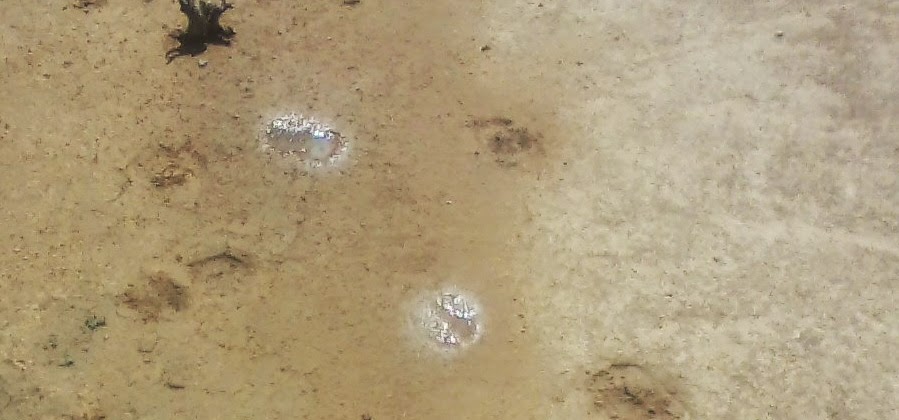
If you read my post on Why Climate Change scientists are clueless and were amazed at the amount of water which runs off after a rain, I underestimated it. Actually I grossly underestimated it as the following picture illustrates.
How much more water would have gone into this ground if cattle were being run as a herd instead of being scattered out? The picture below would have had hundreds of tracks to fill with water instead of just two, which would have captured the water instead of letting it run away.
Before visiting the link from the
Circle Ranch on using the Keyline Plow, here are some things to think
about in order to see the financial benefits as many people can see
the benefits, but think it is too expensive. Yet these same people
are busy making diversion dams and dirt tanks which help some, but
basically are diverting water or holding it so it can water a few cow
and evaporate.
The
cost of sub soiling with the Keyline Plow runs $20 an acre, which
does sound expensive, until you compare the results. $20,000 put into
subsoiling 1,000 acres of ground with scattered grass and forbes will
explode with the first one inch rain (remember, that 1,000 acres just
received 27,154,000 gallons
of water which would have run off). This explosion of grass and
forbes will slow the water and make each subsequent rain be more
effective.
Grazed
properly this can amount to 7 to 9 days of feed for 1,000 cows, or
7,000 grazing days the first year. If one continues to graze
properly, the feed will continue to improve for several years and
continue to hold its feed value (not to mention the wildlife habitat
it creates.) Now lets compare what that same $20,000 will bring with
conventional uses.
Dirt
Tanks- Will hold water for cattle without producing feed. They will
also evaporate water (at a pan evaporation rate of 88” or 55
gallons per square foot) lose 2,395,800 per acre. Figuring the cost
of water being .005 cents per gallon, one is basically throwing away
$11,979 worth of water per every acre of water held in dirt tanks. If
you have 100 acres of water in dirt tanks, you are basically throwing
away $1,197,900 worth of water each year.
Diversion
dams- These will create some feed growth but basically still divert
billions of gallons of water off the ranch rather than into the
ground. Many also have a tendency to wash out and need to be repaired
after a few years.
Hay-
At $230 A 1,000 pound cow eating 3.5% of her body weight will eat 35
pounds of hay a day. To feed 1,000 cows per day would take 17 bales
per day. $20,000 will (almost) buy 87 bales of hay which would feed
1,000 cows five days.
This
means that spending $20,000 to run a Keyline Plow in the proper areas
your money produces nearly twice the actual benefit of hay. While it
would be nearly impossible to calculate the true value of diversion
dams, they are of minimal benefit as they are still diverting water
off your ranch, rather
than putting it into the ground. Dirt tanks have some benefit if you
do not have pump-able water, but otherwise you are letting millions
of dollars worth of water blow away in the wind.
Now that you have an idea of the cost/benefit ratio of the Keyline plow, take a look and see what they have done with it on the Circle Ranch in far west Texas!
The recent standoff between Nevada
Rancher Cliven Bundy and the BLM has stirred a lot of controversy
over federal lands, but it is not the only case. BLM is planning on
seizing 90,000 acres along the Red
River between Texas and Oklahoma. Then we have environmental and
animal welfare groups filing
litigation to stop grazing on federal lands. Despite all of the
talking heads on the radio, and numerous interviews with Senators,
Congressmen, and attorneys, not one person has touched on the fact
that the U.S. Constitution gives the federal government very limited
reasons by which they may own land within the individual states.
Article
1, Section 8, clause 17 of the constitution describes reasons
which the federal government may hold land within the individual
states, as well as the conditions by which they may acquire the land.
This is extremely simple and straight forward language, which I have
broken down and explained below.
To exercise exclusive Legislation in
all Cases whatsoever, over such District (not exceeding ten Miles
square) as may, by Cession of Particular States, and the Acceptance
of Congress, become the Seat of the Government of the United States,
This portion of Section 8, clause 17 is
describing the formation of Washington D.C. As a gift from the
surrounding states to form a Capitol for the fledgling country.
and to exercise like Authority over
all Places purchased by the Consent of the Legislature of the State
in which the Same shall be,
As this line states clearly, for the
federal government to control lands for any reason in any state, the
land must be purchased with the consent of the legislature of that
state. Keep in mind that when any territory east of the Mississippi
River became a state, the new state held title to ALL of the
lands within the new state, other than existing military
installations. For some reason, when the territories west of the
Mississippi River became states, the federal government forced the
territories to cede vast amounts of lands to the federal government
as a condition of statehood.
for the Erection of Forts,
Magazines, Arsenals, dock-Yards, and other needful Buildings
Here we come to the core of the issue.
The ONLY uses for land within the individual states (as laid out in
the Constitution) are for defense. Recreation, mining, petroleum,
grazing, and timber uses are not among the uses described under
Article I, Section 8, clause 17. As this is the only part of the
Constitution describing the conditions and uses for which the federal
government my control lands within the individual states, these uses
are in violation of the Constitution. This would mean the Department
of the Interior, as well as all of its various branches are in
violation of the Constitution and have no jurisdiction within the
individual states.
Taking this case to the Supreme Court
and winning would be fairly simple. First there is the precedence
that ceding land to the federal government was not a condition of
acquiring statehood for territories east of the Mississippi River.
Second, there is actually precedence to the federal government being
challenged to their right to control land under this portion of the
constitution, and the federal government lost in every incidence.
It is time for the states of the west
to come together and take their land and resources back from the
federal government!
Environmental groups are filing
multiple lawsuits in several western states preventing ranchers from
turning out on their leases. In part, these litigations stem from
ranchers not meeting stubble height and riparian regulations. Until
we can get these grazing requirements changed, the only thing we can
do to circumvent more lawsuits is to follow these regulations as
closely as possible.
Trying to control cattle on allotments
using temporary electric fence has proven to be only partially
effective, and barely worth the cost of fencing, let alone extra
labor.
In order to precisely control grazing
to meet federal regulations for stubble height and riparian usage in
an effective way, cattle need to be acting as a herd. When they are
doing this, the cattle graze together and water together. With this
behavior it is a simple matter of a rider catching cattle on their
way to water and deflecting them to a new drinking spot each day,
then sending them out to a new place to graze. My stockmanship
schools are specifically designed for students to learn how to
instill herd instinct so they may easily meet federal allotment
grazing requirements.
Limited to eight riders per class,
classes are entirely hands on. Early morning and late afternoon
sessions students will work on actually instilling herd instinct into
cattle in the pasture. In between pasture sessions students will
concentrate on working cattle in pens. Unlike other schools, we
concentrate on natural reactions cattle have to what we do with our
horses, as well as the horsemanship involved in taking full advantage
of these reactions. By the end of the five days, the pasture cattle will be acting and handling as a herd, and the students will have the pasture cattle acting as a herd like the 500+ cows in the picture below.
The following short video show the changes of behavior between the first and fifth day of the school.
These schools are priced to be economical for students. For more information on schools, or to schedule a school, email me.
Despite millions of acres of evidence supporting it, our colleges and universities have a tendency to ignore holistic planned grazing, or dismiss it as a hoax. However Dr. Richard Teague (PHD) of Texas A &M
not only has researched multi-paddock, planned grazing, he has done a three county, multi-ranch study. This study not only shows the benefits, it also points out the reasons why previous university studies did not work.
In conventional placing, we hold the cattle in one place until they are grazing in different directions. This means that, while the cattle are in the same area, they spread out which also spreads out the herd impact. In placing cattle for holistic, planned grazing, the object is to have the cattle mimic a herd. To do this the cattle need to be as close together as feed and terrain will allow, while grazing in the same direction to maximize herd impact and reduce selective grazing.
To do this we must first move the cattle with the least amount of stress as possible, then slow down the front of the herd until they start grazing and allow the rest of the cattle to catch up. While we can help the cattle in the back catch up, we need to let it all happen. Much of the time it will only take four or five grazing stops to have the cattle acting as a herd and grazing out together, and going to water together.
While on the Ganaderia Valle Colombia Ranch in Mexico we were working on several sets of cattle the first two days rather than concentrating on just one group. We started working on the cattle in this video on Wednesday, and by Friday they were beginning to come together as a herd. At the end of the video you will notice the cattle coming up and grazing towards the cattle at the lead and grazing as a herd.
In another few moves they will have all of the cattle grazing tightly together and be able to graze where they want, when they want, without building more fence while having their herd impact more concentrated than they do in their smaller pastures in the valley floor.
Anyone who has ever ran more than two bulls is familiar with how much fence a couple of bulls can tear out. While at the Ganaderia Valle Colombia ranch in Mexico last week, Octavio Bermudez showed me how they keep the bulls from tearing up the fences at the cell centers. It is a slick method that could be used in other areas.
The problem I was asked to solve is one of the reasons many cattlemen do not want to try holistic, planned grazing. During calving season the cows would leave their calves behind on the daily pasture changes, resulting in a loss of 15 to 20% of the calves. As it turned out, this was a simple problem to solve. This short (2:36 ) video shows how dramatically you can change cattle behavior in a short five days.
One of the benefits of instilling herd instinct in your cattle is that it allows you to create herd impact in areas cattle ignore without going to the time and expense of putting up and tearing down additional fence. The cattle in the picture below were placed there the night before, and spent the night because they wanted to, not because they were fenced in.
While what was accomplished with the cattle is impressive, even more impressive is the amount of forage they have created in only eight years, with nearly half of that being under drought conditions. Before beginning their grazing program, the ranch looked like their neighbor's did in the picture below.
This is what most people assume the desert should look like. Because this is what we have seen land in desert regions look for most, if not all of our lives, we wrongly assume this is what this land is supposed to look like. When talking to old timers, and people whose families have ranched here for generations, we discover that the Chihuahua desert was an immense grasslands up until the last hundred years. Then we started building fences, adding windmills and letting cattle "take care" of themselves.
With a change in grazing patterns, it does not take long for the desert to turn into lush grasslands like the picture below. Alejandro Carrillo was explaining how this grass he is standing in looked exactly like the picture above less than eight years ago. His grazing techniques were the only tools used. No plows or seeds planted other than what the cattle have done.
Looking straight down into the grass, you can't see the ground.
However when you trample the grass down and part it you can see how much seed is getting to the ground.
Occasionally Alejandro feeds cattle, or spreads straw to create litter. The picture below is of a spot where he fed a few bales earlier this year. You read that correctly, this was bare ground only a few months before this picture was taken.
The above results were obtained without the use of any mechanical equipment or seed. The only fertilizer used was that provided by the cattle. While looking at this I was thinking of the number of ranches that will feed calves in a set of pens all winter. Wouldn't it make more sense to put a set of foamed, flat proof tires on your pickup and feed them in a different spot every day? Doing that would allow you to put the gains on your calves while basically getting paid to create more grass!
One other thing which has been happening is the reduction of brush and mesquite without using herbicides. As the grasses get thicker, they are literally choking out the woody plants and killing them as in the picture below. Why would you want to control brush by spending money and time on burning expensive fuel to pull equipment or spraying chemicals which are bad for the environment when you can do it all by simply changing your grazing methods?
The amazing thing about all of this is that the seed is already in the ground. All it needs is enough animal impact and a little rain. Alejandro has been consistently adding grass to Las Damas, even through the drought of the last several years. The diversity of grasses is incredible, including the sprangletop he is pointing out in the picture below.
If you are ranching in an arid, brittle environment, you could be transforming your ranch into one similar to the Rancho Las Damas. For more information on how to accomplish this, visit Holistic Management International and the Savory Institute. Contact me if you would like to hold a stockmanship school on your ranch.
Back in October of 2012 I began a project of using low stress stockmanship to herd 460 cows through a 32000 acre grazing plan. During the course of this grazing season, I did a few experiments to see how much ( if any) increase in forage I could get in areas where cattle normally don't graze. One area was four miles from the water source for the 280 head I placed for one day. I placed approximately 180 head to graze up a draw to the top of a long ridge, and let them keep going back on their own. There was another area which was sub-soiled with the Yeoman Plow just before it was grazed.
All of these areas (and more) improved, some with dramatic results. You can see it for yourself in this video!
I have been asked why this particular combination of animals, and why combine them at all. The reason behind these species is that they just happen to be on this ranch. There are also getting to be more ranches which deal in exotic species rather than cattle or other livestock normally raised on ranches. While the numbers are not high enough to get a lot of animal impact (especially when the pastures are 1,000 acres or larger.) The intent of this experiment is to show that flerds consisting of exotic animals (or a mix of exotic and "normal" livestock) can be herded through a holistic grazing plan. The animal impact will be a bit different as they will spread out more with each species in their own group, but will still have control on which pastures they will graze and when they will graze them.
This week the burros were trapped in a pen and added to the flerd. I put the burros in a pen by themselves and just sat there for a bit, Then I positioned myself so the burros would go past me. The first few times they went pretty fast. By the fourth or fifth time they figured out they weren't being chased and slowed down to a walk. I worked them around me a few times and when they got to the point I could stop them easily, I turned them out with the rest of the flerd.
By Friday everything in the pens was getting along fairly well. On Friday I turned the flerd out into a small trap of several hundred acres. I held the burros back and let them out of the pen last, rode past them to the longhorns in the lead, and turned them back to have everything grazing across the west side of the trap. Once I got them headed the way I wanted I went back and bumped the burros a little farther from the gate, stopped them and rode off. I had a bad video week (capped off by closing the lens cover as I was letting them out) so I don't have any video this week. On Sunday I will be moving them around the trap, and turning them into an adjacent pasture on Monday. It will be interesting to see how far apart the various species stay from each other, and how putting them together and moving them as a group will work (or if I'll have to move each species as a separate group.) Hopefully I'll have some decent video next week, but in the meantime, enjoy these pictures.
The above picture shows just how much the burros have settled down. When they were first turned in they refused to allow a lama or alpaca to get close to them.
This is definitely a mismatch, but this alpaca doesn't seem to notice the size difference.
Here is the flerd after I turned them out. The burros had stopped just outside the gate and I moved them about fifty yards then stopped them. It will be interesting to see how well everything moves together when I turn them out in the pasture this week. Hopefully I'll get some usable video!
The Circle Ranch has asked me to develop a multi species herd (called a flerd) out of some of the animals on the ranch.The plan is to create a flerd by combining horses, longhorn cattle, lamas, alpacas and BLM burros.
The burros have not been handled, so the hardest part will be getting them into the pens. Last Tuesday I managed to get them from the Middle Pasture into a trap next to headquarters. To accomplish this I opened the gate I wanted them to go through and rode to the back of the pasture. As soon as I spotted the burros I stopped and stood there until they started moving away from me, then dropped out of site. There was a stud horse and two geldings at the gate when the burros reached it. When the stud made a short charge at the burros, I was far enough out that I loped in the same direction as the burros and managed to stop them. After nearly an hour of applying and releasing pressure a single step at a time, the burros left and the horses followed them through the gate. I continued acclimating them to seeing a person horseback for a couple of hours. When I decided they had enough for the day, I released them to walk down a fence. Unfortunately, when they reached the county road (and a cattle guard) the stud horse made another run at them, chasing them across the cattle guard, and following them into the next trap. I waited until things calmed down and removed the stud horse and his compadres to another pasture where they will be out of the way.
In the meantime, the rest of the flerd is beginning to shape up. There are peculiar challenges with this project, mainly with the alpacas and lamas. The males of these two species fight for dominance on a daily basis, which makes it difficult to combine groups of these species with each other, let alone other species. Interestingly enough, it seems that the neutered alpacas and lamas will still fight for dominance. To get around this I have removed the most aggressive males. They still fight, but the fights are a lot shorter.
In order to keep the stress levels as low as possible, I work these animals around a pen, or through several pens. Then I place the animals on feed in a separate pen. I cannot stress stress enough on how much stress is created by calling animals to feed. When we create the "Pavlov's Dog" response in animals the more aggressive animals are always on feed first leaving those lower in the pecking order to fight over what is left. Cattle which are grazing as a herd and acting as a herd will begin eating then scattering out after being fed because of the stress. However, by placing stock on feed this extra stress is removed. As you will see in the video below, the varied species in this flerd are beginning to eat with each other in only six days. This is largely because they are being placed on feed rather than going through the stress of the horses driving the cattle off feed and the cattle driving off the lamas and alpacas.
When most people think of roping, they think of it as it is done in the arena. Run hard, throw a loop and jerk the animal around so another person can rope the heels and stretch an animal out as fast as they can. Cowboys often feel that this is the only, or at least the fastest way to get cattle doctored in the pasture. Just like low stress stockmanship, the original Vaquero style of roping appears to be slow, but is actually faster and more efficient in the long run.
A good example was one ranch I was on where we were having a scours/ pneumonia wreck. Between two of us, we were doctoring up to 160 calves a day, or 80 to 90 calves apiece everyday. By using the old style big loop style that people consider to be "fancy," I was able to accomplish it without having to change horses at noon everyday. My cattle stayed calm and easy to handle. At the same time the other guy (who constantly cussed me for "packing a clothesline") not only had to change horses everyday at noon, but the cattle he was doctoring on would take off at a trot as soon as he rode into view.
There are several secrets to why big loop roping are low stress.
Variety of available loops. Rather than being limited to either a conventional run them down head or heel loop, a person will have four or five varieties of head and heel loops to fit different scenarios.
This variety of loops, combined with low stress handling methods allows a person to do the vast majority of their roping at a walk or trot.
Allows ropers to handle cattle without constantly choking them because of the style of hondos used.
As you can see in the picture to the right, this style of hondo will give an animal a chance to breath when the rope is slackened. While allowing an animal to have slack on the end of the rope may sound strange, in actuality is allows the animal to remain calm. This helps in two ways. If a person is doctoring cattle too large to wrestle to the ground, it allows you to trot a couple of circles around the animal (having them step over the rope with their front feet), basically heeling them so you can pull them over with minimal effort. If two people are doctoring, this allows the heeler to throw their loop and get the animal down for treatment with minimal stress on the cow and minimal effort on their horse. Combined, this method allows you to doctor more cattle on fewer horses while keeping your cattle from getting wild.
Many people are reluctant to try the big loop style of roping because they are afraid of getting tangled up in the "extra" rope. The best way to learn is to practice on a roping dummy, then rope cattle using a breakaway hondo. If you do something wrong, instead of being tied to a cow, the hondo will release the rope. Once you get to the point of being able to stop your cattle with the breakaway hondo like in the video below, you are ready to start roping for real. Between the variety of loops and distance they can be thrown, you will be able to doctor more cattle in a day, with less effort than you ever thought possible.