All of these areas (and more) improved, some with dramatic results. You can see it for yourself in this video!
Showing posts with label grazing. Show all posts
Showing posts with label grazing. Show all posts
Wednesday, August 21, 2013
Forage Improvement Results From Holistic Herding
Back in October of 2012 I began a project of using low stress stockmanship to herd 460 cows through a 32000 acre grazing plan. During the course of this grazing season, I did a few experiments to see how much ( if any) increase in forage I could get in areas where cattle normally don't graze. One area was four miles from the water source for the 280 head I placed for one day. I placed approximately 180 head to graze up a draw to the top of a long ridge, and let them keep going back on their own. There was another area which was sub-soiled with the Yeoman Plow just before it was grazed.
All of these areas (and more) improved, some with dramatic results. You can see it for yourself in this video!
All of these areas (and more) improved, some with dramatic results. You can see it for yourself in this video!


Friday, March 1, 2013
Correction On "Do Bigger Calves Make More Money"
Even though it does not change the
fact that 500 pound calves can make you more money overall than 700
pound calves, I have to admit to making a mistake. Rather than 500
pound calves being worth more than the 700 pound calves, the 700
pound calves were actually worth $80 more. (Which should teach me to
use a calculator after midnight).
So how do you make more money with
the 500 pound calves? A 1250 pound cow consumes 16.5 pounds more feed per
day than a 700 pound cow. This comes to 495 pounds a month more hay
or 2,475 pounds over the course of a five month winter feeding
season. Even if you put up your own hay and can do so for only $100 a
ton, the $80 market advantage just dropped by over $100, resulting in
the 500 pound calves earning you $20 more per head, or $2,000 more per 100
calves (plus the additional 78 cows you could be running.)
The difference in consumption between
the 1,250 pound cow and the 700 pound cow will also allow you to run
178 of the lighter cows for every 100 of those bigger cows on the
same amount of forage and hay.
There have been people who commented
that a 700 pound cow can't raise a 500 pound calf. In the 1970's and
early 80's there were people doing just that by running smaller
framed crossbred cows and taking advantage of hybrid vigor. Around
the mid 80's feeders and packers were wanting bigger framed cows, and
moderate framed cows fell by the wayside. By the early 90's
previously moderately framed cattle such as Red Angus cows were
weighing in at 1,800 pounds. Everyone jumped on the “bigger calves”
bandwagon without thinking of the extra money it costs to raise those
bigger calves.
Basically it boils down to an income of
$101,500 on 100 of those 700 pound calves or $166,430 on 178 of those 500 pound
calves with the same feed base. During times of drought, the extra money made by being able to run more of the lighter cattle could be the difference between selling out, or keeping the ranch.
For information on my services, visit NaturalCattle
Handling.com If you would enjoy a laugh or two, take a look at my
cowboy humor and cookbooks at the 2lazy4U
Livestock & Literary Co.
Thursday, October 25, 2012
Herding A Bovine Potpourri
Some people have asked how herding
cattle in this way is more efficient than controlling them with
fences. For starters, you don't have to buy, build and maintain (or
continually move) extra fencing,and you need fewer water points.
Using this method on yearlings or dry cows (and receiving them all at
once) is much, much, easier than receiving a Bovine Potpourri a
little at a time. Despite the challenges, and necessary adjustments
the program is still working, and improving.
One adjustment I've had to make is
using more than one water point. It seems that these cattle have a
tendency to jump in the five foot drinkers and stand there, then
break the float on their way out. Once, I saw a cow
standing in a drinker with her calf next to her, nursing (something I have never seen before.) This forced us to designed and
install a modification to the existing float guards which will
hopefully take care of this problem. While having to work off of more than
one water point makes it take longer to place cattle, it has been a
learning experience.
The second pasture in the rotation I had five
water points to work off of. The interesting thing was that, even
though the cattle were mixed where they were grazing, they would
return to the water point they came from. In the case of grazing
associations, this could have some benefits if the herd instinct was
instilled in each herd before going to summer pasture. The
association rider could place the cattle on different water points, and keep the cattle separate within the same allotment. At the end of the grazing season it would be simple to gather each owner's cattle separately, and decrease the shrink involved with sorting several herds simultaneously (which would in return, increase profits a minimum of 3 to 5% ).
Despite the difficulties this
particular project has, it is still working. Rather than spending
money on labor building and maintaining (or moving) fences several
times a week (or daily), one person spends three days placing cattle
where they need in the pastures. Because of the social and
physiological differences within this herd, and using multiple water
points, placing within the pasture does take all day. If the water
system was simplified to a single water point, and the cattle were
all the same class, placement within the pasture would take four
hours or less (for a total of 12 hours of labor per week.)
Despite the diversity of this group of cattle and using multiple water points, we are still getting the desired results of taking roughly a third of the forage and also getting animal impact distributed across the pasture, as shown in the following photograph. 

While they are spread out to fit feed density, the following picture shows roughly 100 head working as a herd. Notice how they are all grazing in the same direction. Once we make the next pasture move at the end of next week, we will be able to wean the bigger calves at a set of pens next to a water point. Once the cows have bawled off, I will start all of the cattle up a canyon in the direction of the next pasture in the grazing plan and allow the cattle to sort themselves into two groups.
Open cattle, older calves, bulls and those in the first and second trimester of pregnancy will pick up and move out easily, while those cattle in their third trimester, calves under a month old and older thin cows with calves on them will take their time getting started. This will make it easier to instill the herd instinct into the cattle and (hopefully) keep the bulls away from the cows which are calving. (One problem with running bulls year round is that 12 to 24 hours before calving, cows change from producing progesterone to estrogen. This change in hormones causes cycling cows and bulls to seek out and ride cows beginning to calve, causing dystocia.)

Tuesday, September 13, 2011
Are Current Pasture Conditions The Fault of Drought or MAnagement?
There is one thing I have noticed on nearly every ranch I have visited this year that disturbs me. Nearly every ranch has large areas of unused grass that cattle won't eat because it is gray, matted and rank. Some ranches have literally thousands of acres of this (currently) useless grass. The cause of this is not the drought, but conventional low density continuous grazing methods.
The biggest problem with low density grazing is that cattle are creatures of habit, as are many of their owners. Once cattle are located in an area they tend to keep going back to the same location. This results (especially on larger ranches) in cattle grazing one area to the ground while ignoring other areas which become entirely inedible for both livestock and wildlife. Either scenario results in little available forage for livestock or wildlife during times of drought. Why do the gray matted areas of grass exist?
They exist is because cattle have been comfortable in past years where they were at without grazing these areas. Without enough animal impact these areas have gone through their growth cycle several times to the point that two things happen. First, not enough sunlight is getting to the new grass to create the photosynthesis needed for growth. Secondly, when rains are measured in trace amounts of moisture rather than inches, not enough moisture reaches the ground to make grass grow. Is it possible to repair these areas enough to induce growth with minimal amounts of rain?
Actually it is simple. Many (if not most) ranches are feeding cake. Being the creatures of habit we are, we continue to feed the same cattle in the same area every time we feed. By feeding cake or hay on these dry matted areas we will be using herd effect to both trample the matted grass into the ground (allowing more sunlight for photosynthesis) while also tilling the ground with the hooves of the cattle, which allows rain to soak deeper into the ground.
For some reason, there are many people who do not believe that herd effect allows for more efficient plant use during times of minimal moisture. There is an easy experiment you can do to discover what herd impact has without using a single cow.
You can use either bare hard ground, or a patch of ground where you have gray matted grass. Measure out a 10 X 20 foot plot, then cut them in half. To simulate a short term, high density herd impact, rake one of the 10 X 10 about ½ and place a rain gauge at the halfway point of the dividing line. Place a sprinkler so that both plots receive the same amount of moisture, until the rain gauge has about ¼ inch. Then compare the amount of penetration of the water.
To see results from doing this, visit Dan Dagget on You-Tube for the kind of results you can achieve. As usual, your comments and suggestions are welcome!
Thursday, July 7, 2011
Improve Forage & Hydrology By Grazing "Impossible" to Graze Locations
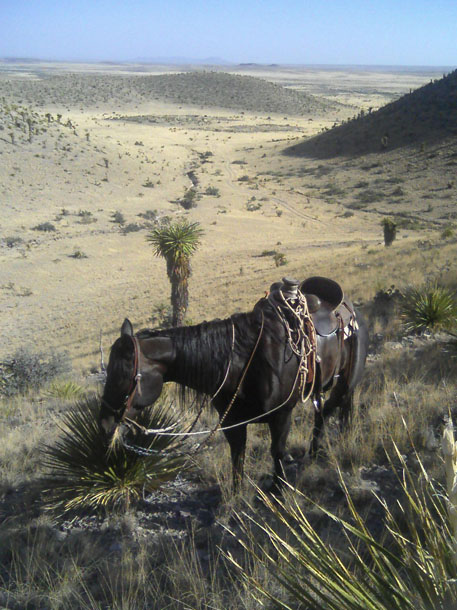 |
While the cattle were being rotated through the pasture in the picture to the left, they were, for the most part, allowed to graze where they wanted. You can tell where they grazed by following the outline of the healthy yellow grass. As soon as the ground began to get too steep, or too rocky, the cattle would ignore it in their grazing pattern.
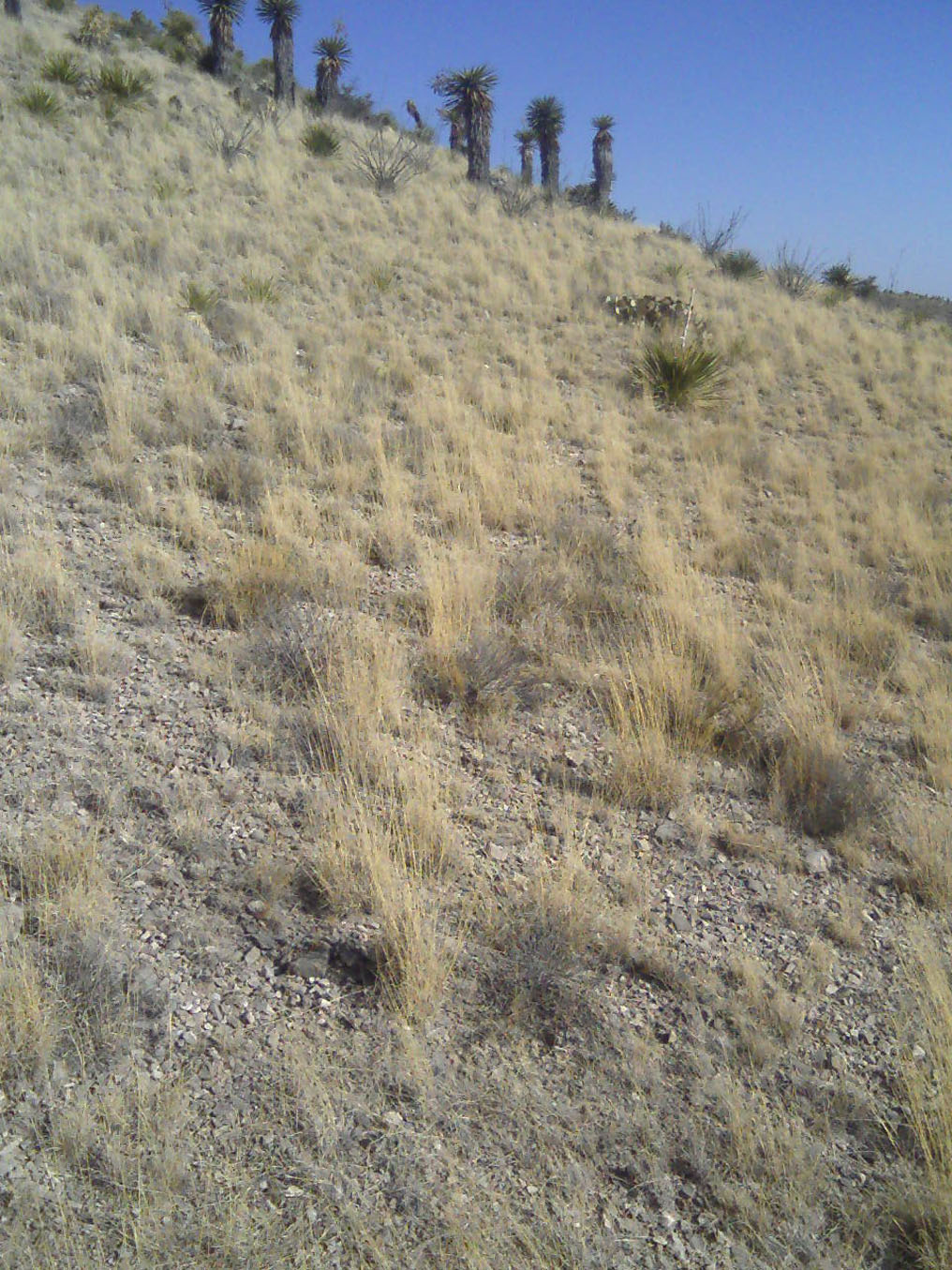
Upon closer inspection of these rocky areas, there is grass, but it is gray, matted and very unhealthy.

The results of this are in the picture below. Notice the grass is healthier and had much more growth than in the picture above. This is the result of grazing the cattle through this area one time. By utilizing "impossible to graze" slopes such as this you are improving biodiversity, hydrology, and stocking rates. At the very least, utilizing these areas will allow you to run at full capacity (as prescribed by conventional) methods while giving each grazing area once every two years. Feel free to ask questions or make comments below.
Subscribe to:
Posts (Atom)