Friday, December 16, 2011

Are You Managing Wildlife, Livestock, Or Forage ?

Look at nearly any help wanted ad looking for ranch management and it is fairly obvious that every ranch has it's management priorities. The problem in developing management programs which focus on a certain species of animal is that they are so focused on developing a program for your particular niche that we develop tunnel vision. When we hire a manager with a specific degree to manage for our specific management niche we are often focusing our tunnel vision even more. More often than not we are like a drug addict too stoned to notice we are shooting ourselves in the foot. This is especially true in wildlife managers who have been taught that livestock competing for forage is detrimental to wildlife populations.


The tunnel vision developed by an educational system which focuses on niche management tends to overlook the bigger picture. Environmentalists and wildlife managers want to remove livestock from the land to protect it. However this is often counter productive to forage development and diversity. Many of us have, for one reason or another, come to the conclusion that if we leave the land to nature, that nature will heal the land on it's own. The only problem with this theory is that nature today is not what nature was even a hundred years ago. We  have removed the tool nature used to develop forage and plant diversity. This tool of nature was large herds of free roaming grazers that grazed through an area and were gone for a period of time, letting the land and plants rest. This grazing pattern loosened the top of the soil allowing rain to soak into the ground rather than run off, removed the top two thirds of plants allowing light to reach the base of plants speeding up photosynthesis while fertilizing the ground from feces and urine.

 When we took away the tools nature has provided to take care of itself, we minimized our chances of real improvement or even sustaining what forage we have. The only way we can viably sustain and improve the forage and environment for wildlife is to find a substitution for the tools of nature which are no longer available. 

The substitution for the large herds of grazing animals is controlled rotational grazing of  livestock. The most effective method is by training a herd of stock to act as a herd and place them in a different area to graze on a daily basis. This does not mean having a person with the herd all day, but simply training your stock to act as a herd and place them on a daily, or near daily basis. To find out more of how easy it is to train livestock to act as a herd, and how this kind of grazing system can improve conditions for your game animals and birds, visit the following websites:

By using these methods you will not only be helping improve the ecology of your ranch, but also providing food for the world.


Friday, December 2, 2011

Cattle Handling's Best Kept Secret

With all of the articles and videos on reduced stress cattle handling, how can there be a “secret?” To be honest, I didn't realize it was a secret until I started watching some videos on how to pull cattle in a feedlot. Time after time I watched the experts pass up perfect opportunities to to take advantage of this but they never attempted to use it. By not using it, their average time to make a pull in their videos was approximately eight minutes. As anyone who has ridden health in a feedlot knows, taking this long to pull a single cow is not feasible, especially during the fall run when a person may be pulling over 100 sick animals a day.
This secret no one talks about requires a handler to abandon conventional wisdom, human instinct and think like a cow. When a cow cuts across the pen conventional wisdom and human instinct both tell us to keep our horse parallel to the cow and get to the head so we can stop it. The problem is that (even when we are successful) we are putting pressure on the cow to speed up before it stops. If we get the cow stopped, we still need to get it turned towards the gate. If we don't get it stopped, we are starting all over again. So what is the best kept secret to keep a cow calm and turn in the direction we want?
.
The secret lies in thinking about what the cow is doing and removing both the desire and opportunity to do this. We cause the desire to go around us when we put on too much pressure. When we try to get ahead of the animal to stop it we are, for as long as it takes us to do so, are putting pressure on the cow to go faster. In order to slow the animal down and get it to turn the way we want, we need to take away both the pressure and opportunity.
To do this all we have to do is widen the gap between ourselves and the cow while still tracking it. As the gap widens the pressure we are putting on the cow lessens. At the same time we are far enough away that the desire to go around us also goes away. At this point the cow will either stop, or turn away from us.
If we train our horses to move laterally this will allow us to give cattle that extra space whenever a cow starts to cut across the pen and prevent it from happening in the first place. This one little “secret” will allow you to pull cattle not only in a calmer manner, but faster as well.

 For more information For more information, or to have me help you with your cattle handling, visit my main website or email me

Tuesday, September 13, 2011

Are Current Pasture Conditions The Fault of Drought or MAnagement?

There is one thing I have noticed on nearly every ranch I have visited this year that disturbs me. Nearly every ranch has large areas of unused grass that cattle won't eat because it is gray, matted and rank. Some ranches have literally thousands of acres of this (currently) useless grass. The cause of this is not the drought, but conventional low density continuous grazing methods.

The biggest problem with low density grazing is that cattle are creatures of habit, as are many of their owners. Once cattle are located in an area they tend to keep going back to the same location. This results (especially on larger ranches) in cattle grazing one area to the ground while ignoring other areas which become entirely inedible for both livestock and wildlife. Either scenario results in little available forage for livestock or wildlife during times of drought. Why do the gray matted areas of grass exist?

They exist is because cattle have been comfortable in past years where they were at without grazing these areas. Without enough animal impact these areas have gone through their growth cycle several times to the point that two things happen. First, not enough sunlight is getting to the new grass to create the photosynthesis needed for growth. Secondly, when rains are measured in trace amounts of moisture rather than inches, not enough moisture reaches the ground to make grass grow. Is it possible to repair these areas enough to induce growth with minimal amounts of rain?

Actually it is simple. Many (if not most) ranches are feeding cake. Being the creatures of habit we are, we continue to feed the same cattle in the same area every time we feed. By feeding cake or hay on these dry matted areas we will be using herd effect to both trample the matted grass into the ground (allowing more sunlight for photosynthesis) while also tilling the ground with the hooves of the cattle, which allows rain to soak deeper into the ground.

For some reason, there are many people who do not believe that herd effect allows for more efficient plant use during times of minimal moisture. There is an easy experiment you can do to discover what herd impact has without using a single cow.

You can use either bare hard ground, or a patch of ground where you have gray matted grass. Measure out a 10 X 20 foot plot, then cut them in half. To simulate a short term, high density herd impact, rake one of the 10 X 10 about ½ and place a rain gauge at the halfway point of the dividing line. Place a sprinkler so that both plots receive the same amount of moisture, until the rain gauge has about ¼ inch. Then compare the amount of penetration of the water.

To see results from doing this, visit Dan Dagget on You-Tube for the kind of results you can achieve. As usual, your comments and suggestions are welcome!

Thursday, September 8, 2011

Widening Your Focus

One of the advantages to thinking holistically is that you are open to more than one avenue of thought when it comes to problem solving. While there are times that the reason for a problem may be obvious, at others there may be a variety of causes for a problem. The problem with not thinking holistically is evident in a recent experience. 
  
I had the opportunity to be involved in a grass survey so that a family could determine whether or not they wanted to graze cattle this winter. This West Texas ranch focuses on hunting quail, deer, sheep, and antelope, using cattle as a tool to improve range conditions. Several of the owners had reluctantly agreed to the holistic grazing as they have their doubts about whether or not grazing could improve range conditions. For the last several years the deer and antelope have not been reproducing, and quail numbers have been dropping.

The only reason that the people reluctant to try holistic grazing can see for this (beyond the current drought) is that the cattle are to blame. They are so narrow in their focus they cannot see that forage conditions on their ranch did not improve until they began grazing. They also cannot seem to grasp the fact that game numbers should automatically improve when forage improves. When it does not, you have a problem which is not related to limited grazing with cattle. In order to uncover the cause of your problems you must look at all of the changes made in management as well as possible biological reasons not directly related to management.

The two biggest management changes concerning the quail were installing waterline for quail drinkers and changing methods for supplementing quail feed. The water shouldn't make a difference but may (which I will cover in the next paragraph.) Presently they are feeding a free choice quail block. To see quail feeding on these blocks, you have to be there at exactly the right time. The old method was feeding millet out of a pickup. Like Pavlov's dog, the quail would be drawn to the road every time a pickup went by. Now with more cover(from the grazing) and no reason to come to the road, they are seeing no quail.
When range conditions improve, fertility of the game animals should increase, resulting in more, not fewer deer and antelope fawns. As the forage conditions across this ranch are dramatically better than before they grazes (and astronomically better than their neighbors) they need to be looking at the whole picture to see what the problem could be. Do they have a parasite problem? Is there a disease such as brucellosis or vibriosis which displays its by abortions?

One other improvement which happened at the same time as grazing began, was new water wells were drilled and tied into the existing water system. This is also apparently just prior to the time deer and antelope started having fewer young, and quail numbers dropping in the improved areas.
With all of these possibilities the only “reason” some of these owners can see that could cause the problems is grazing. Rather than graze areas of the ranch which (especially in this time of drought) could be improved they have decided not to graze. This decision will not be detrimental to the ranch, but it will not solve the problems they have. It would not be difficult to start eliminating the causes of the problems.
First, check the new wells for contamination (which could be a toxic mineral). Second, begin feeding the quail from the pickup again to see if quail numbers suddenly increase. If the wells are not contaminated, tranquillize several deer and antelope and take blood and fecal samples to see where the problem lies.

To manage holistically you have to be aware of the whole without being overly focused on only a small portion of it. Doing so only slows progress and prevents you from solving problems in a timely manner!

Sunday, August 7, 2011

The Myth of Regional Neccessity

Recently a person asked the question if  there is a part in Texas where there is much of the Vaquero tradition going on.Of course the conversation expanded from horses, to handling cattle in various parts of the country.One of the opinions expressed was that cattle in Texas, because of their breeding, big pastures and brush, are wilder than cattle in other parts of the country. Having worked on ranches from California east to Nebraska, and from the Montana/Canadian border, south to Texas I have come to the realization that the only reason cattle are wilder in one are that the other comes down to the way cattle are handled.

While it is true that the longer cattle go without seeing a person horseback, the stronger their flight response will be when they are gathered and worked. However part of the process of taking care of cattle is actually going through them from time to time. If you do this, and handle your cattle in a way they understand, your cattle will not be trotty and run off every time you gather them.
A big (Ok, VERY big) part of the problem people have in areas claiming they "have" to handle cattle in a hurry is that they are pushing cattle too hard on the way to the pens, then pressuring them too much when they get there. In the above picture five of us were moving over 600 pair to a summer pasture of around 5,000 acres. There were a few clearings, but most of the summer lease was just like in the picture. Rather than just ignore them all summer, I rode them once a week (twice if I was lucky). That fall the five of us went back in and gathered, driving them right back through the brush and accounted for every single head.

This brings us back to "regional necessity" of having big crews to handle one or two hundred head at a time. If that is really necessary, you should be looking closely at your herd management and the way you are handling your cattle. Bigger crews add to outputs, as does unnecessary shrink from cattle that are trotty to gather. I've been on ranches that were either still open range, or had pastures as big as fifty thousand acres with cattle that were easy to handle, just because people made a point of riding through them from time to time. It all boils down to the fact that if your cattle are trotty and run off, it is because of the way you manage and handle them.


Monday, July 25, 2011

Un-constitutionality of Federal Lands

The following videos are from a discussion surrounding the fact that most federally controlled lands are un-constitutional as per Section 8, clause 17 of the U.S.Constitution. Included in the discussion is how to get these lands returned to the individual states as well as reaching out and educating the public on this issue and agriculture in general.


Thursday, July 7, 2011

Improve Forage & Hydrology By Grazing "Impossible" to Graze Locations


 While holistic grazing programs can improve the biodiversity and hydrology of a pasture the source of erosion usually begins on steep side hills. As these areas are often ignored by cattle, and are hard to fence, so they are left out of grazing plans as being "impossible" to graze. The fact is, it is not only possible to graze these areas, they are prime locations to improve both forage and hydrology of pastures.

While the cattle were being rotated through the pasture in the picture to the left, they were, for the most part, allowed to graze where they wanted. You can tell where they grazed by following the outline of the healthy yellow grass. As soon as the ground began to get too steep, or too rocky, the cattle would ignore it in their grazing pattern.

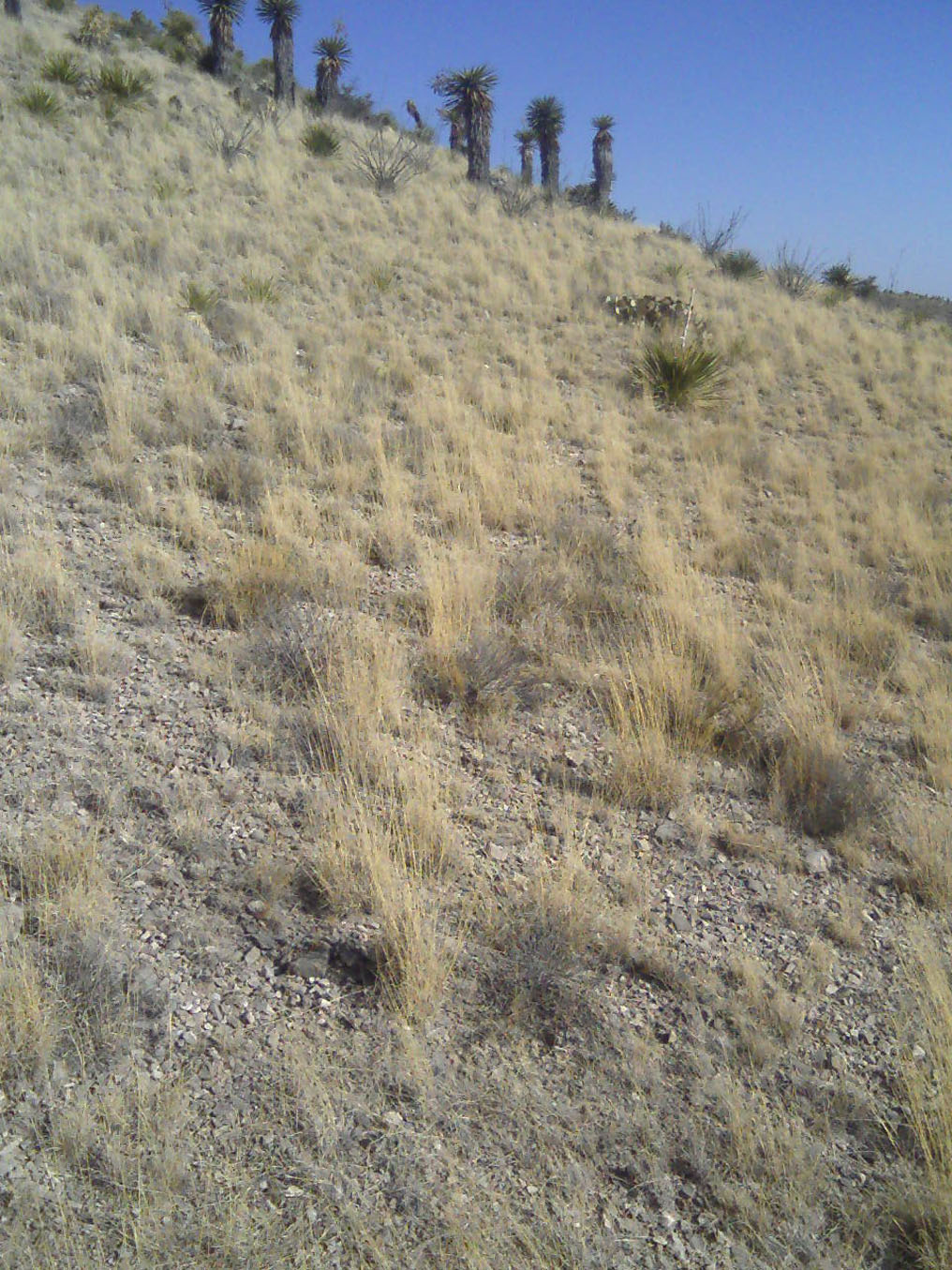
Upon closer inspection of these rocky areas, there is grass, but it is gray, matted and very unhealthy.
The picture above shows just how sparse and unhealthy this grass is. When it rains, there is not enough grass to slow water down and erosion begins. Notice in the above picture that some clumps of grass have no individual stalks of grass while others have just a few.  In the picture below, I conducted a short experiment the last time cattle were in this pasture. Taking roughly two hundred cows, I herded them up a side hill to graze on steep, rocky ground with the grass in a condition similar to the picture above.

The results of this are in the picture below. Notice the grass is healthier and had much more growth than in the picture above. This is the result of grazing the cattle through this area one time. By utilizing "impossible to graze" slopes such as this you are improving biodiversity, hydrology, and stocking rates. At the very least, utilizing these areas will allow you to run at full capacity (as prescribed by conventional) methods while giving each grazing area once every two years. Feel free to ask questions or make comments below.